MERN Stack Roadmap for Beginners(2026): From Basics to Job-Ready Projects
Many beginners start learning MERN Stack with excitement, but after a few weeks they feel confused.
They watch React tutorials, then jump to Node.js, then copy a MongoDB project, then get stuck when the frontend does not connect with the backend. This happens because MERN Stack is not just a list of four technologies. It is a complete way of building web applications.
A good MERN Stack roadmap for beginners should help you understand what to learn first, what to avoid, which tools to practice, and how to move from basic coding to complete projects.
This guide is written for students, freshers, beginners, career switchers, and parents who want a practical learning direction instead of random advice. Students who prefer structured classroom learning can also explore practical MERN Stack training in Mohali.

Who This MERN Stack Roadmap Is For
This MERN Stack roadmap is designed for beginners who want to move from basic web development to practical full stack projects.
It is useful for:
- BCA, MCA, B.Tech, and CSE students
- Final-year students preparing for project work or internships
- Freshers who want to enter web development
- Career switchers moving toward software development
- Non-technical students who are serious about learning coding
- Parents who want to understand whether MERN Stack training is practical or only theory-based
If you are from Mohali, Chandigarh, Kharar, Zirakpur, Panchkula, or nearby areas, this guide will help you understand what a practical MERN Stack learning path should actually include.
What Beginners Should Understand Before Learning MERN
Before learning MERN Stack, understand one simple idea:
MERN helps you build complete web applications.
A full stack application has three major parts:
| Frontend | What users see and interact with | React |
| Backend | Where business logic runs | Node.js and Express |
| Database | Where application data is stored | MongoDB |
| APIs | How frontend, backend, and database communicate | REST APIs |
For example, in a student management app:
- React shows the form and student list.
- Node.js and Express handle form submission.
- MongoDB stores student records.
- APIs help React send and receive data.
This is why MERN should not be learned as four separate topics. It should be learned as one connected development flow.
What Beginners Should Avoid in the Beginning
Many students waste time because they start MERN Stack in the wrong order.
- Do not jump directly into React without JavaScript basics.
- Do not copy full MERN projects without understanding the flow.
- Do not focus only on UI design and ignore backend logic.
- Do not learn MongoDB only through definitions.
- Do not skip Git and GitHub.
- Do not ignore debugging.
- Do not think a certificate alone makes you job-ready.
- Do not learn advanced tools before building basic projects.
Practical warning: If you cannot explain how data moves from a React form to a backend API and then into MongoDB, you are not ready to call yourself full stack yet. That does not mean you are weak. It simply means you need more structured practice.
Stage 1: Build Web and JavaScript Foundations
The first stage is not MERN directly. It is web development foundation.
Beginners should first learn HTML, CSS, responsive layouts, JavaScript fundamentals, DOM basics, functions, arrays, objects, events, promises, Fetch API, and basic error handling.
You do not need to become an advanced JavaScript developer before React. But you should be comfortable with how data, functions, events, and API calls work.
Practice Ideas for This Stage
- To-do list
- Calculator
- Quiz app
- Form validation page
- Expense tracker
- Simple search and filter app
These projects may look basic, but they teach important thinking. A student who understands JavaScript properly will learn React much faster than someone who only memorizes React syntax.
Students looking for a short-duration introduction to JavaScript, React, Node.js, Express, MongoDB, and frontend-backend connection can explore the 45 Days MERN Stack Training in Mohali.
Stage 2: Learn React for Frontend Development
After JavaScript basics, move to React.
React helps you build user interfaces using reusable components. Instead of writing everything in one large page, you break the interface into smaller, manageable parts. Students can also refer to the React official documentation while practising frontend concepts.
React Concepts Beginners Should Learn
- Components, JSX, props, and state
- Events, forms, conditional rendering, lists, and keys
- Hooks, routing, API integration, and basic state management
At this stage, do not rush into advanced libraries. First understand how React thinks.
Practice Ideas for React
- Student card listing
- Notes app
- Weather app using an API
- Blog listing page
- Product listing page
- Login form UI
- Dashboard layout
A common beginner mistake is building beautiful UI but not understanding data flow. React is not only about design. It is about managing user interaction and application state.
Stage 3: Learn Node.js and Express for Backend Development
Once frontend basics are clear, start backend development.
Node.js allows JavaScript to run on the server side. Express helps you create backend routes and APIs. The Node.js official learning resources can help students understand the role of Node.js in backend development.
Backend Concepts Beginners Should Learn
- What a server does
- How requests and responses work
- Express routes and middleware
- Controllers and API structure
- JSON responses and error handling
- Environment variables and basic security awareness
For example, when a user clicks “Submit” on a React form, the backend receives that data, processes it, and sends a response.
Practice Ideas for Backend
- Add student API
- Get all students API
- Update student API
- Delete student API
- User login API
- Blog post creation API
- Product listing API
Use tools like Postman or Thunder Client to test APIs before connecting them to React. This habit helps beginners identify whether an error is coming from the frontend, backend, or database.
Stage 4: Learn MongoDB and Database Thinking
MongoDB is where your application data is stored.
Beginners should learn database basics, collections, documents, CRUD operations, schema design basics, Mongoose models, relationships between data, validation, and querying data.
Do not learn MongoDB only as commands. Learn how data should be structured in a real application.
Example: Task Manager App
Before writing code, think about the data:
- What data should a task contain?
- Should each task belong to a user?
- How will completed and pending tasks be stored?
- How will the frontend display filtered tasks?
This is called database thinking. It is one of the most important skills for becoming more confident in full stack development.
Stage 5: Connect Frontend, Backend, and Database
This is the most important stage in MERN learning.
Many students know React separately, Node separately, and MongoDB separately. But when asked to connect everything, they get stuck.
You should practise the complete full stack flow:
- User enters data in React.
- React sends data to a backend API.
- Express receives the request.
- The backend validates the data.
- MongoDB stores the data.
- The backend sends a response.
- React updates the UI.
This is where MERN Stack starts making real sense.
Practice Project for This Stage
Build a basic student management system with:
- Add, view, edit, delete, and search students
- MongoDB data storage
- React success and error messages
- Backend validation
- API-based frontend-backend connection
This project is simple, but it teaches the complete MERN Stack flow clearly.
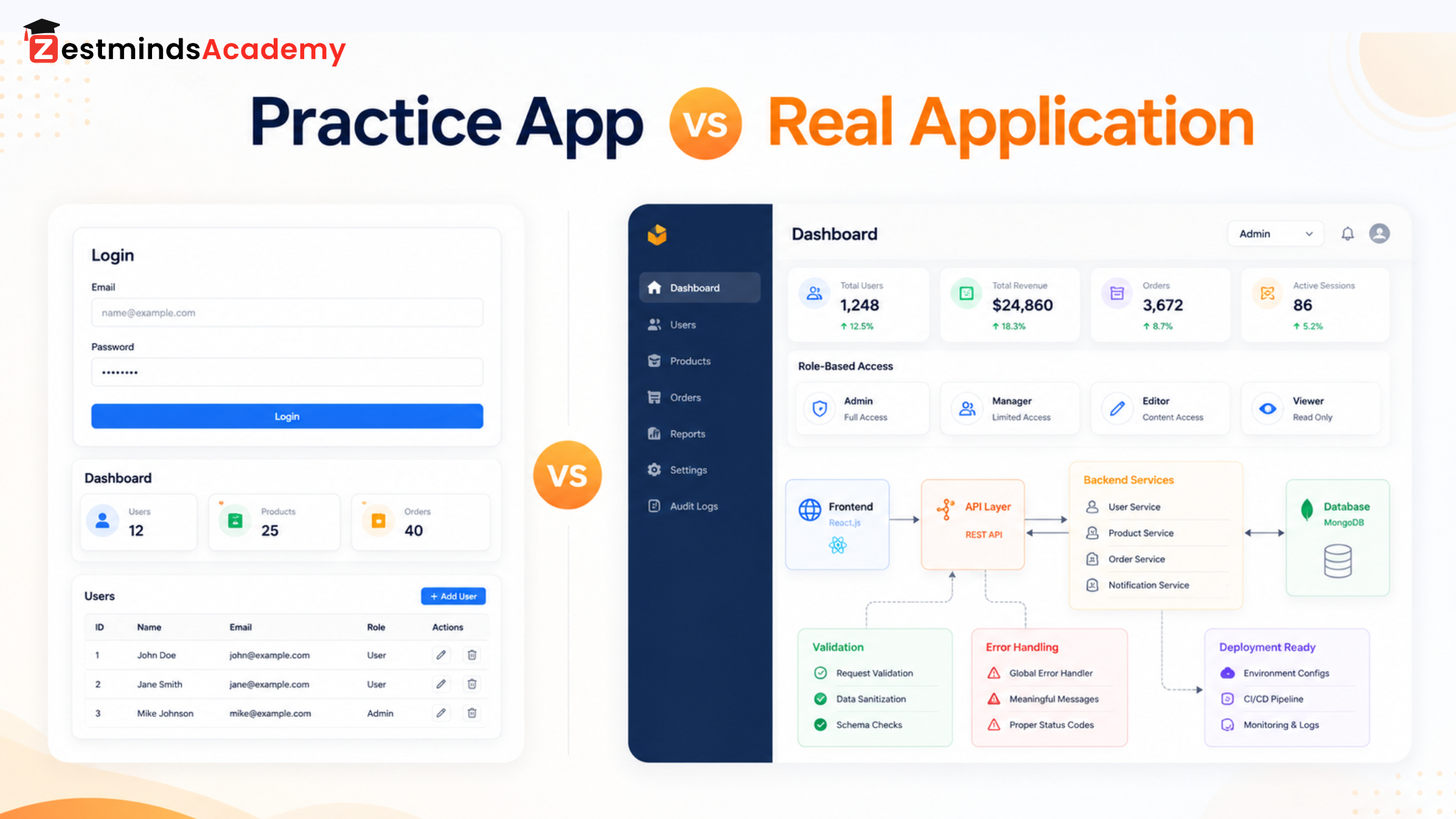
Once your CRUD application is working, read why many MERN projects still look like practice apps. It explains how user flows, validation, UI states, backend structure, permissions, and database planning make a project feel more complete.
Stage 6: Add Git, APIs, Authentication, and Deployment
After building connected projects, learn the tools that real developers use.
| Version Control | Git, GitHub, commits, branches, repositories |
| API Testing | Postman, Thunder Client, request and response testing |
| Project Setup | npm, environment variables, project structure |
| Security Basics | Authentication, JWT basics, password hashing basics |
| Deployment | Frontend hosting, backend hosting, environment setup, and a live project link |
Authentication is especially important because many real applications need login and user access control.
Start with a simple login and signup system. Do not try to build advanced role-based systems immediately. First understand the basics properly.
Deployment is also important because a project on your laptop is not enough. Students should learn how to host the frontend and backend, manage environment variables, and share a working project link.
Stage 7: Build Portfolio-Level MERN Projects
Once your basics are clear, start building portfolio-level projects.
Good MERN project ideas for students include:
- Task management app
- Blog application
- Student management system
- Inventory management system
- Basic job portal
- Event registration system
- E-commerce product module
- Admin dashboard
- Learning management mini app
- Appointment booking system
Do not build projects only for names. Build projects you can explain.
Interview Questions Your Project Should Help You Answer
- Why did you build this project?
- What problem does it solve?
- How does the frontend connect with the backend?
- How did you design the database?
- What errors did you face?
- How did you deploy it?
- What would you improve next?
A small but complete project is better than a large copied project.
Tools and Technologies Beginners Should Learn
A practical MERN learner should slowly become comfortable with the full development toolkit.
| Frontend | HTML, CSS, JavaScript, React, React Router, Axios or Fetch, and basic UI libraries |
| Backend | Node.js, Express.js, REST APIs, middleware, controllers, and authentication basics |
| Database | MongoDB, Mongoose, CRUD operations, and basic schema design |
| Developer Tools | Git, GitHub, VS Code, Postman, Thunder Client, npm, Browser DevTools, and deployment platforms |
You do not need to master every tool before building projects. Learn enough, build, face errors, fix them, and improve.
That is how real development confidence is built.
Common Beginner Mistakes in MERN Stack Learning
Here are the common mistakes students should avoid while following a MERN Stack roadmap.
Learning React Before JavaScript
React becomes confusing when JavaScript basics are weak. Spend proper time on arrays, objects, functions, promises, and API calls.
Watching Tutorials Without Coding
Watching gives familiarity. Coding gives skill. Always code along and then rebuild without watching.
Copying Projects Without Understanding
Copied projects may look impressive, but they do not help in interviews if you cannot explain the logic.
Ignoring Backend
Some students spend too much time on frontend design and avoid backend because it feels difficult. But MERN is full stack. Backend cannot be skipped.
Skipping Git
Git is not optional. Students should learn basic commits, branches, GitHub repositories, and README files.
Not Debugging Properly
Errors are part of development. Beginners should learn how to read error messages instead of immediately asking someone else or restarting the project.
Not Completing Projects
Many students start five projects and complete none. Complete fewer projects properly.
Career Direction After Learning MERN Stack
MERN Stack can support several beginner-level career directions, depending on your effort, project quality, and interview preparation.
- Frontend developer
- React developer
- Backend developer with Node.js
- Full stack developer intern
- Junior MERN developer
- Web development intern
- Project trainee
- Freelance web developer for small projects
Honest advice: Learning MERN Stack does not automatically make someone job-ready. Job-readiness comes from consistent coding, project completion, debugging ability, communication, GitHub work, and interview preparation.
For freshers, the goal should be clear:
- Build 2–3 complete projects
- Understand the code properly
- Maintain GitHub repositories
- Write basic documentation
- Practise explaining projects
- Prepare common JavaScript, React, Node, and database questions
Final-year B.Tech, BE, BCA, and MCA students can also explore 6 months internship training in Mohali and Chandigarh if they want structured MERN project exposure, mentor guidance, and career preparation after learning the basics.
How Practical Training Helps Beginners
Many beginners try to learn MERN Stack through random videos. Some students succeed with self-learning, but many get stuck because they do not know what to learn next or how to fix errors.
Practical training helps students get:
- A structured learning order
- Regular coding practice
- Doubt-solving support
- Project guidance
- Debugging help
- Interview preparation
- Realistic feedback from trainers
- Better understanding of the development workflow
For local students around Mohali and Chandigarh, classroom-based practical training can be helpful because doubts are solved while students are actually coding.
At Zestminds Academy, the focus is on practical MERN Stack learning through guided classroom training, project exposure, and learning from working software professionals. The aim is not just to finish the syllabus, but to help students understand how real applications are planned, built, tested, and explained.
Students who want guided learning can explore Zestminds Academy’s MERN Stack Training in Mohali for React, Node.js, Express, MongoDB, APIs, authentication, Git, deployment, and project-style practice.
Final Advice for Beginners
Do not learn MERN Stack randomly.
Follow this practical order:
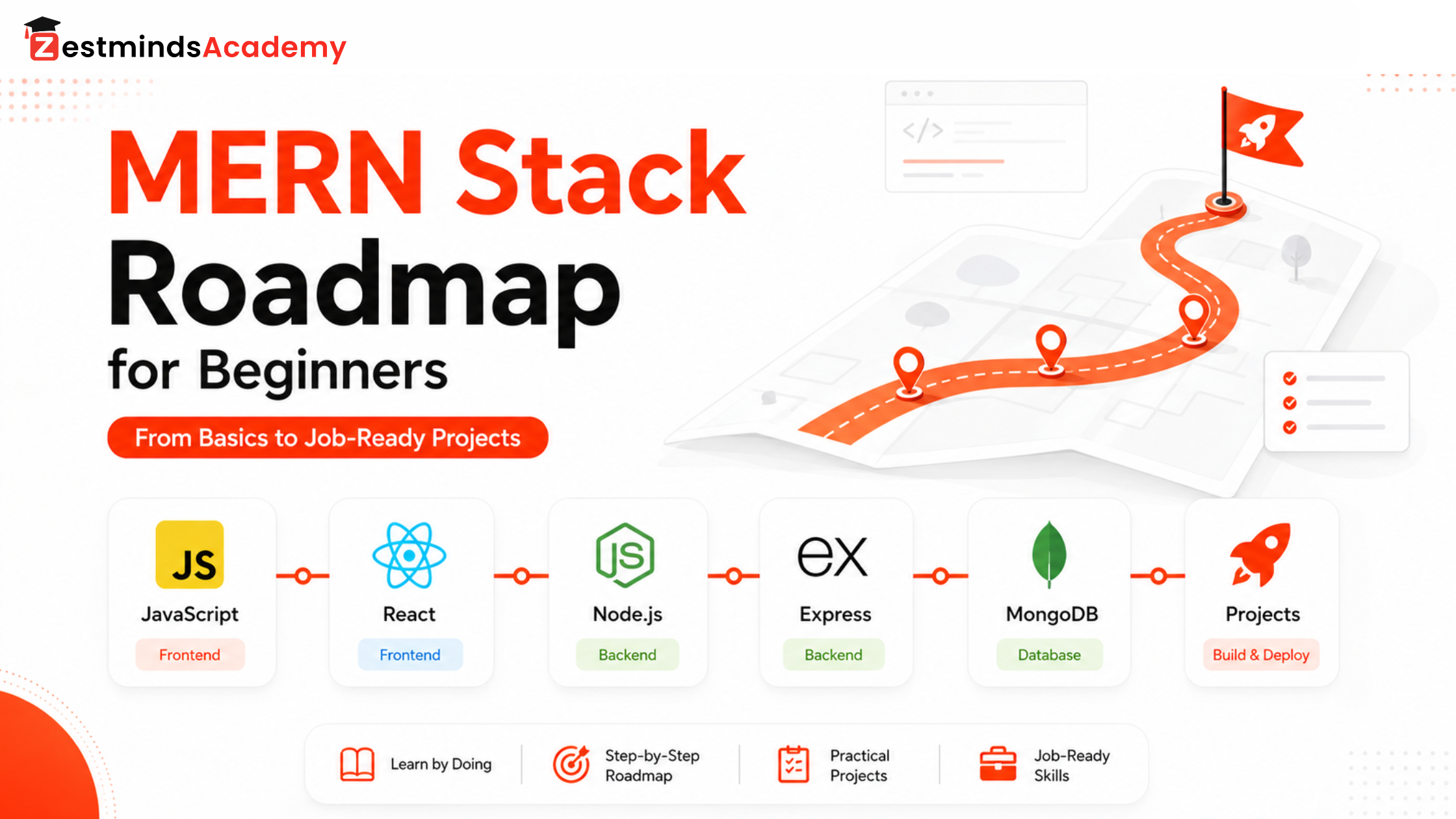
Web basics → JavaScript → React → Node.js → Express → MongoDB → APIs → Authentication → Projects → Deployment → Interview preparation
Do not worry if everything feels connected and confusing in the beginning. That is normal. Full stack development becomes clear when you build projects and connect each part step by step.
The goal is not to complete tutorials.
The goal is to build, debug, explain, and improve.
After completing the foundation in this roadmap, follow the guide on what to learn after MERN Stack basics to understand project architecture, authentication, role-based access, TypeScript, SQL basics, deployment, Git workflow, and advanced project development.
That is what moves a beginner closer to real development readiness.
FAQs
Is MERN Stack good for beginners?
Yes, MERN Stack can be good for beginners if they learn in the right order. Students should first build a foundation in HTML, CSS, and JavaScript before moving to React, Node.js, Express, and MongoDB.
What should I learn before MERN Stack?
Before MERN Stack, learn basic web development, JavaScript fundamentals, functions, arrays, objects, DOM basics, promises, and API calls.
Should I learn React first or JavaScript first?
Learn JavaScript first. React becomes easier when you understand JavaScript basics like functions, arrays, objects, events, promises, and data handling.
How long does it take to learn MERN Stack?
It depends on your current level and practice consistency. Beginners usually need structured learning, regular coding, and multiple projects to become confident.
Is React enough for full stack development?
No. React is only the frontend part. To build complete applications, students also need backend, database, APIs, authentication, and deployment basics.
What MERN projects should beginners build?
Beginners can build a task manager, student management system, blog app, product listing app, login dashboard, or basic e-commerce module.
Can non-technical students learn MERN Stack?
Yes, but they may need more time with programming fundamentals and JavaScript before moving into full stack projects.
Is MERN Stack useful for freshers?
Yes, MERN Stack can be useful for freshers if they build complete projects, understand the code, maintain GitHub repositories, and prepare for interviews.
How does practical training help in MERN Stack?
Practical training helps students follow a clear roadmap, solve doubts, debug errors, build projects, and understand how frontend, backend, and database work together.
What is the biggest mistake beginners make while learning MERN?
The biggest mistake is learning tools separately without building complete applications. MERN makes sense when React, Node.js, Express, MongoDB, and APIs are connected in projects.
Table of Contents
- Who This MERN Stack Roadmap Is For
- What Beginners Should Understand Before Learning MERN
- What Beginners Should Avoid in the Beginning
- Stage 1: Build Web and JavaScript Foundations
- Stage 2: Learn React for Frontend Development
- Stage 3: Learn Node.js and Express for Backend Development
- Stage 4: Learn MongoDB and Database Thinking
- Stage 5: Connect Frontend, Backend, and Database
- Stage 6: Add Git, APIs, Authentication, and Deployment
- Stage 7: Build Portfolio-Level MERN Projects
- Tools and Technologies Beginners Should Learn
- Common Beginner Mistakes in MERN Stack Learning
- Career Direction After Learning MERN Stack
- How Practical Training Helps Beginners
- Final Advice for Beginners
- FAQs
Raghav Mahajan
Stay Ahead with Expert Insights & Trends
Explore industry trends, expert analysis, and actionable strategies to drive success in AI, software development, and digital transformation.
Begin Your Journey to a Successful Tech Career
Talk to our mentors and choose the right training program.
Call us: +91-9056277961
Email us: hello@zestmindsacademy.com