AI Agents Are Growing Fast: What Python Students Should Actually Learn First
AI agents are suddenly everywhere.
You may see YouTube videos saying “Build an AI agent in Python,” LinkedIn posts talking about agentic AI, and courses claiming that AI agents are the next big thing.
But for a student, fresher, or career switcher, the real question is not just:
“How do I build an AI agent?”
The better question is:
“What should I learn first so I can understand AI agents properly and build them with confidence?”
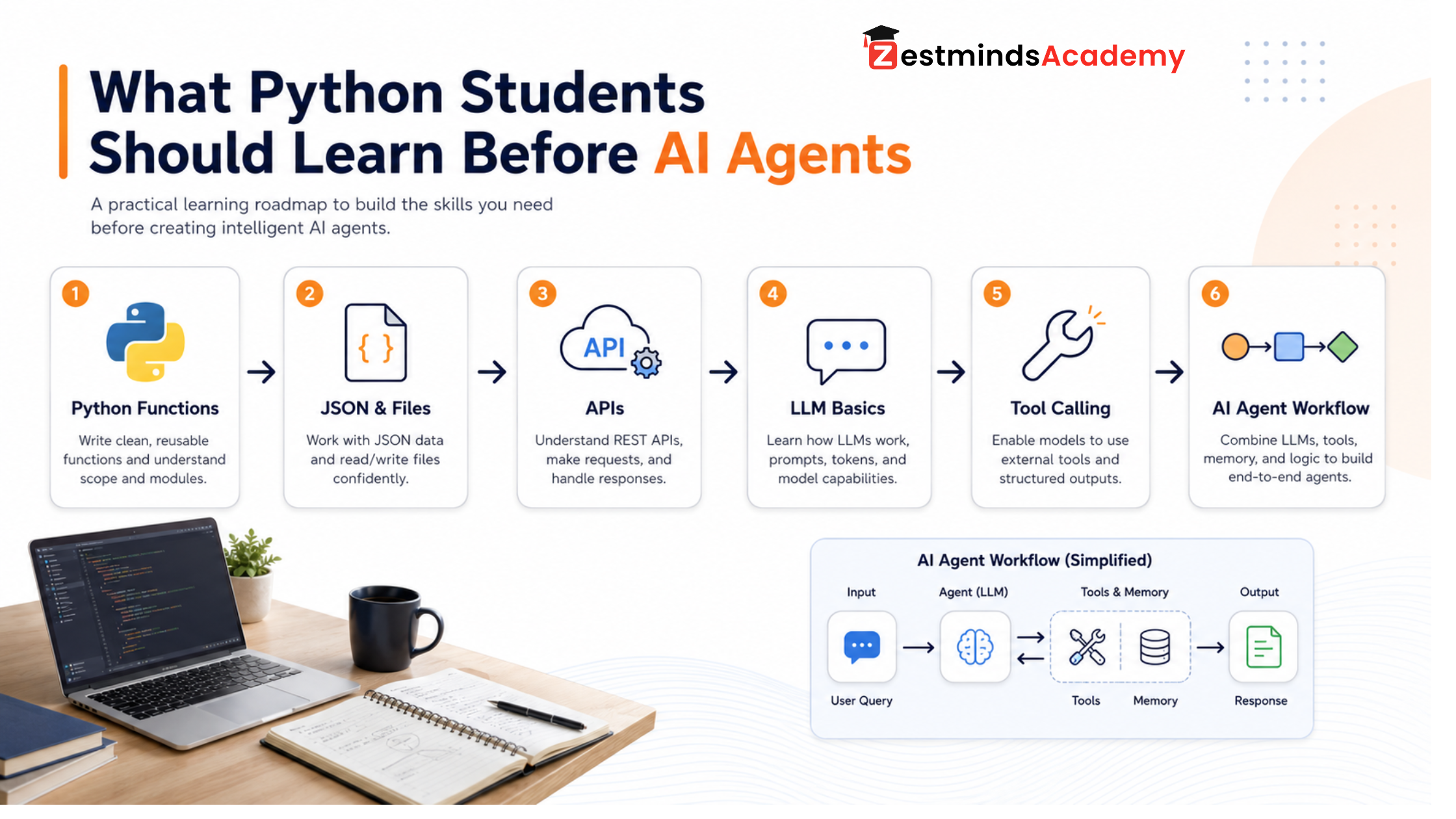
This guide explains what Python students should learn before AI agents, including Python fundamentals, APIs, JSON, LLM basics, tool calling, debugging, and small project workflows.
It is written for beginners, BCA/MCA/B.Tech students, freshers, non-technical learners, and career switchers who want practical clarity instead of random tool-based learning.

Why AI Agents Are Suddenly Getting So Much Attention
A normal chatbot mostly answers questions.
An AI agent goes one step further.
It can understand a task, decide what information is needed, call a tool or function, use data, and then respond with a result. For example, instead of only answering “What is the weather?”, an AI agent may call a weather API, get live data, process the result, and then answer.
OpenAI’s function calling documentation explains how models can connect with external tools and systems, which is one of the core ideas behind many AI agent workflows. OpenAI function calling documentation
This is why AI agents are being discussed in areas like:
- Customer support
- Data analysis
- Research assistance
- Report generation
- Software automation
- Personal assistants
- Business workflow automation
For students, this trend matters because it is not only about “AI theory.” It is about building software that uses AI practically.
What an AI Agent Actually Means for a Python Student
LangChain’s documentation explains an agent as “a model calling tools in a loop until a given task is complete.” LangChain agents documentation
For students, this definition is useful because it shows one important thing:
An AI agent is not just a prompt.
An AI agent usually needs:
- User input
- A language model
- Python functions or tools
- Data access
- API calls
- Memory or conversation history
- Rules and validation
- Error handling
- A final response
Think of an AI agent like a junior assistant inside software.
It can understand instructions, but it still needs proper tools, clean data, clear rules, and checks. If the tool is wrong, the agent may fail. If the data is messy, the response may be poor. If the Python code has errors, the agent will not work properly.
AI agents are not magic. They are software workflows where an LLM thinks, calls tools, checks data, and responds. That is why students need programming fundamentals, not just prompt writing.
Should Students Directly Start with LangChain, CrewAI, or AutoGen?
Many beginners make this mistake.
They hear about LangChain, CrewAI, AutoGen, or other agent frameworks and directly start copying tutorials. For one or two videos, everything looks exciting. But when an error comes, they get stuck.
The problem is not always the framework.
The problem is that the student does not yet understand the foundation behind the framework.
Before using advanced agent tools, a student should understand:
- How Python functions work
- How data is passed between functions
- What JSON is
- How APIs return responses
- How prompts affect output
- How to debug errors
- How to structure a small project
Frameworks are useful, but they are not the first step for every learner.
| Learning stage | Better focus | Avoid starting with |
|---|---|---|
| Beginner | Python basics, functions, conditions, loops | Complex multi-agent frameworks |
| Basic Python learner | Files, JSON, APIs, simple LLM calls | Production-level agent systems |
| Intermediate learner | Tool calling, memory, small projects | Over-engineered architectures |
| Project-ready learner | LangChain, CrewAI, RAG, deployment basics | Blindly copying tutorials |
A good rule is simple:
First understand the workflow. Then learn the framework.
What Python Students Should Learn First Before AI Agents
This is the most important part.
A student does not need to become an advanced machine learning engineer before starting AI agent development. But they do need practical Python and software thinking.
Here is the learning order that makes more sense.
| Stage | What to learn | Why it matters for AI agents |
|---|---|---|
| Python fundamentals | Variables, functions, loops, conditions | Agents need logic and decision flow |
| Data structures | Lists, dictionaries, sets, tuples | Agent data is often structured |
| File handling | Text files, CSV, JSON | Agents may read and write files |
| APIs | Requests, responses, REST APIs | Agents connect with external tools |
| Error handling | try-except, logs, debugging | AI apps fail often |
| LLM basics | Prompts, tokens, context | Helps understand model behavior |
| Tool calling | Python functions connected to LLMs | Core concept behind agents |
| Memory/context | Previous messages, stored user data | Agents need continuity |
| Project structure | Clean folders, modules, reusable code | Needed for real applications |
Before jumping into AI agent frameworks, students should first become comfortable with Python fundamentals like functions, dictionaries, files, JSON, and APIs.
From a training institute perspective, this is where many students struggle.
They may know basic Python syntax, but they are not confident in using Python to build something. They can define a list or function, but they cannot connect that function to a real workflow.
For AI agents, that gap becomes visible very quickly.
For example, if an agent needs to check course information from a JSON file, call an API, and then answer a student’s query, you need more than basic syntax. You need to understand how data moves through the system.
That is why practical assignments matter.
Do You Need Machine Learning Before Learning AI Agents?
This is a common fear.
Many students think:
“If I do not know machine learning deeply, can I still learn AI agents?”
Yes, you can start.
For beginner-level AI agent development, you do not need deep machine learning mathematics from day one. Many practical AI applications use existing LLM APIs. Your first goal should be to understand how to use those models properly inside software.
At the beginning, focus on:
- Python
- APIs
- Prompts
- LLM behavior
- Data handling
- Tool calling
- Debugging
- Small project workflows
Machine learning becomes useful later when you go deeper into topics like embeddings, RAG, model evaluation, fine-tuning, classification, recommendations, and data science workflows.
Students who want to go deeper into embeddings, RAG, and model evaluation can later build a stronger data science and machine learning foundation.
So do not use machine learning as an excuse to delay learning AI applications.
But also do not skip fundamentals and expect frameworks to do everything.
Simple Example: How an AI Agent Workflow Looks
Let us take a simple example.
Imagine a student course guidance AI agent.
A student asks:
“I know basic Python. Which course should I learn next?”
A simple chatbot may give a general answer.
But an AI agent workflow can be more practical:
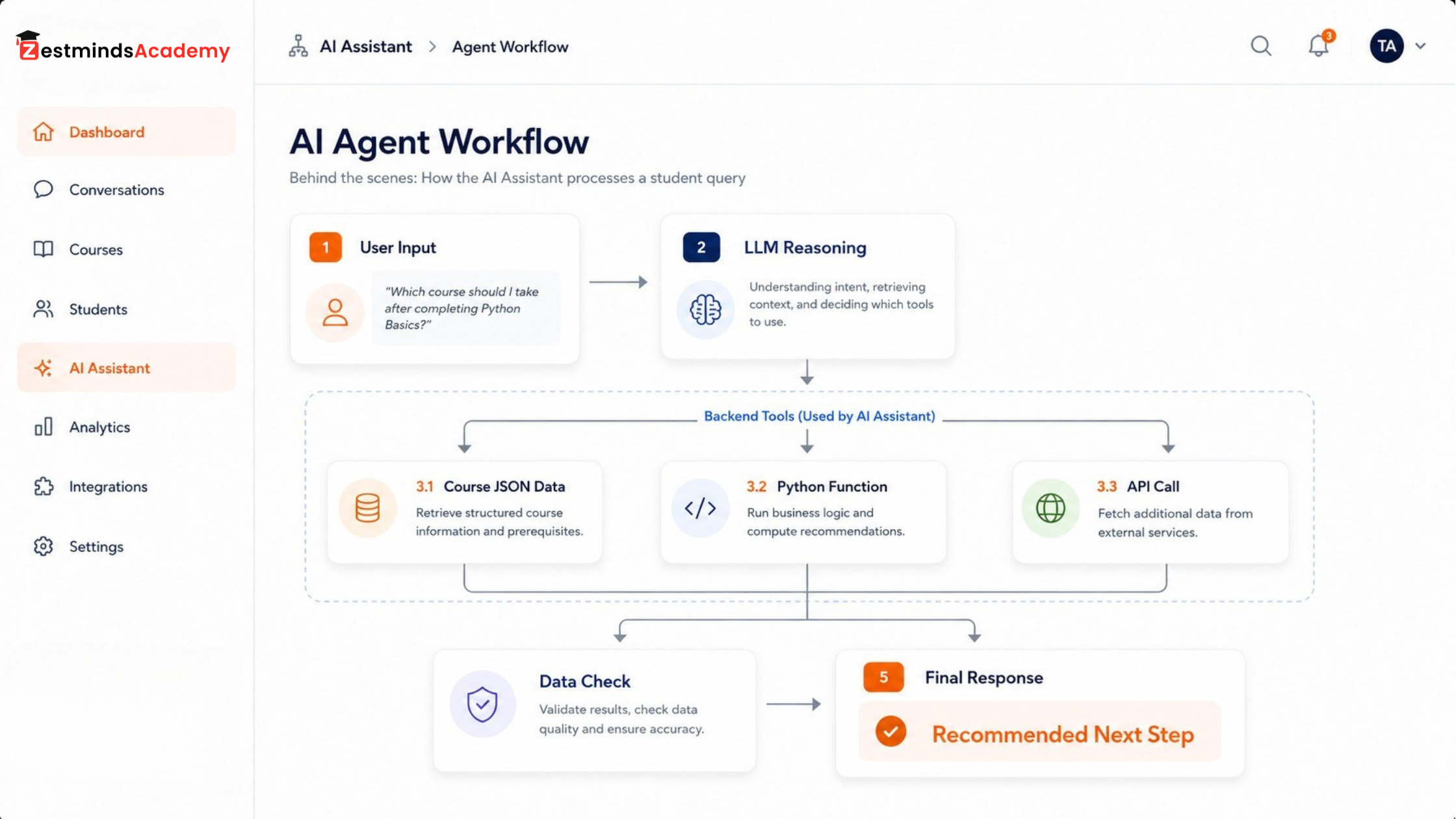
Student question → Agent understands the intent → Agent checks available course data → Agent asks for missing details if needed → Agent suggests a suitable learning path → Agent can save the enquiry or forward it to a counsellor
From outside, this looks simple.
But inside, the system may need:
- Python functions
- Course data in JSON or database
- Prompt instructions
- Rules for recommendation
- API connection
- Error handling
- Conversation memory
- A safe final response
This is why AI agents are interesting for students. They show how Python, data, APIs, and AI can work together in one real application.
Common Mistakes Students Make While Learning AI Agents
AI agents are exciting, but beginners often take the wrong path.
Here are common mistakes to avoid.
Mistake 1: Skipping Python basics
If you cannot write functions confidently, agent frameworks will feel confusing.
Mistake 2: Copying tutorials without understanding
Copying code may give you output once, but it will not help when something breaks.
Mistake 3: Learning too many tools together
LangChain, CrewAI, AutoGen, vector databases, MCP, RAG, and deployment are all useful topics. But learning everything at once creates confusion.
Mistake 4: Thinking prompts are enough
Prompt writing is useful, but AI agents also need logic, tools, data, and validation.
Mistake 5: Ignoring debugging
AI applications fail in different ways: wrong output, API errors, timeout issues, bad data, token limits, or unclear prompts. Debugging is not optional.
Mistake 6: Believing AI agents are always correct
Agents can make wrong decisions. That is why validation, rules, and human review are important in many real workflows.
Before learning advanced AI agents, check yourself:
- Can I write Python functions confidently?
- Can I work with dictionaries and JSON?
- Can I call an API and read the response?
- Can I debug basic errors?
- Can I explain what a prompt is doing?
- Can I build a small Python project without only copying code?
If the answer is no, start there first.
What Real Skill-Building Looks Like for Students and Freshers
For students, the goal should not be to build a big AI product immediately.
The goal should be to build small, clear projects where you understand every part.
Good beginner project ideas include:
- Python FAQ chatbot
- CSV-based data assistant
- Resume feedback assistant
- Course recommendation assistant
- Simple customer support assistant
- Weather API assistant
- Document Q&A assistant
- Basic RAG assistant
These projects are useful because they teach how AI works inside software.
For many students from Mohali, Chandigarh, Kharar, Zirakpur, and Panchkula, the real challenge is not finding AI content online. The challenge is learning it in the right order with practical guidance.
Freshers should try to move from tutorial-based learning to real project exposure, where they learn how AI applications behave outside simple examples.
Parents also need to understand this clearly: AI learning is not only about using ChatGPT. A serious student should learn how AI is integrated into real applications.
How Structured AI/LLM Training Helps
Random learning can work for some students, but many beginners get lost because they do not know the correct order.
One day they watch a Python video. Next day they start LangChain. Then they jump to RAG. Then they hear about AI agents. After two weeks, they feel confused.
Structured training helps by giving a proper path:
Python foundation → APIs and data handling → LLM basics → tool calling → AI workflows → guided projects
At Zestminds Academy, the focus is not to make students memorize theory. The goal is to help them understand how modern AI applications are actually built, debugged, and improved.
For students who already know basic Python and want to understand how AI, LLMs, and agent-based applications are built in real projects, they can explore Zestminds Academy’s practical AI/LLM training in Mohali.
Final Thoughts
AI agents are growing fast, and students should take the trend seriously.
But do not chase tools blindly.
The students who will benefit most are not the ones who only copy “build an agent in 10 minutes” tutorials. The stronger students will be the ones who understand:
- Python logic
- APIs
- JSON and data handling
- Prompt behavior
- Tool calling
- Debugging
- Project structure
- Where AI systems can fail
AI agents are not just about AI.
They are about building useful software with AI inside it.
If you understand that, you will learn this field with much more clarity.
Explore Zestminds Academy’s AI/LLM training in Mohali or talk to a course mentor to understand the right learning path.
FAQs
What should Python students learn before AI agents?
Python students should first learn Python fundamentals, functions, data structures, file handling, JSON, APIs, error handling, prompts, LLM basics, and tool calling. These skills make AI agent development easier to understand.
Is Python required for learning AI agents?
Python is not the only language for AI agents, but it is one of the most practical choices because it is widely used for AI libraries, APIs, automation, backend development, and data handling.
Can beginners learn AI agents?
Yes, beginners can learn AI agents, but they should not directly start with complex frameworks. They should first build confidence in Python, APIs, prompts, and small AI application workflows.
Do I need machine learning before AI agents?
Not in the beginning. You can start with LLM APIs, prompts, Python, and tool calling. Machine learning becomes more useful later when you move into embeddings, RAG, model evaluation, and advanced AI systems.
Should I learn LangChain or CrewAI first?
Learn the basics first. Once you understand Python functions, APIs, JSON, prompts, and tool calling, frameworks like LangChain or CrewAI become easier to understand.
Are AI agents useful for freshers?
Yes, AI agents can be useful for freshers if they learn them practically. The value is not in knowing tool names. The value is in understanding how to build, test, and debug AI-powered workflows.
Table of Contents
- Why AI Agents Are Suddenly Getting So Much Attention
- What an AI Agent Actually Means for a Python Student
- Should Students Directly Start with LangChain, CrewAI, or AutoGen?
- What Python Students Should Learn First Before AI Agents
- Do You Need Machine Learning Before Learning AI Agents?
- Simple Example: How an AI Agent Workflow Looks
- Common Mistakes Students Make While Learning AI Agents
- What Real Skill-Building Looks Like for Students and Freshers
- How Structured AI/LLM Training Helps
- Final Thoughts
- FAQs
Rajat Sharma
Stay Ahead with Expert Insights & Trends
Explore industry trends, expert analysis, and actionable strategies to drive success in AI, software development, and digital transformation.
Begin Your Journey to a Successful Tech Career
Talk to our mentors and choose the right training program.
Call us: +91-9056277961
Email us: hello@zestmindsacademy.com