Python Course Fees in Mohali: Duration, Scope & Projects
“What is the Python course fee in Mohali?”
That is a fair question. Fees matter, especially for students, freshers, and parents who are comparing different training options. But fee alone does not tell you whether a course will actually help you build skills.
For many parents, the concern is not only the fee. They also want to know whether their child will gain confidence, practical project experience, and better career direction after the course.
A better question is:
“After completing this Python course, what will I be able to build on my own?”
If a course only gives notes, theory, and a certificate, it may not be enough. But if it helps you write code, solve errors, build projects, understand databases, and prepare for interviews, then the training becomes much more useful.
This guide will help you understand Python course fees in Mohali, duration options, career scope, project examples, and what students should check before joining any Python training program.

Python Course Fees in Mohali
Python course fees in Mohali can vary depending on the course duration, trainer experience, curriculum depth, batch format, project work, and career support.
At Zestminds Academy, the Python training fee is:
₹4,000 per month
The total fee depends on the training path a student chooses, such as:
- 3-month Python training
- 6-month Python training
- Internship-based Python training
At ₹4,000 per month, a 3-month course may roughly cost ₹12,000, and a 6-month course may roughly cost ₹24,000, depending on the final training plan selected.
Students should always confirm the latest fee, batch timing, course duration, and course structure before admission because the final plan may depend on the selected learning path.
A short beginner course may cost less, but it may only cover basic syntax. A more practical course may include projects, database basics, APIs, Django/Flask introduction, GitHub guidance, resume support, and interview preparation.
So, while comparing fees, do not only ask:
“How much is the fee?”
Also ask:
“What will I learn, practice, and build during this course?”
Students looking for a practical program can explore the Python training in Mohali page for course details.
What Affects Python Course Fees?
Two Python courses may have the same title, but the learning experience can be completely different.
One course may only teach variables, loops, and functions. Another may help students build projects, connect Python with databases, understand APIs, and prepare for interviews.
Here are the main factors that affect Python course fees:
| Factor | Why It Matters |
|---|---|
| Duration | Longer courses usually allow more practice, revision, and project work. |
| Curriculum depth | A beginner-only course is different from a course that includes APIs, databases, and frameworks. |
| Trainer background | Working software professionals can explain how Python is used in real projects. |
| Projects | Projects help students build confidence and portfolio work. |
| Batch size | Smaller batches usually make doubt-solving easier. |
| Career support | Resume, GitHub, interview, LinkedIn, and project explanation support add practical value. |
| Batch format | Offline, online, hybrid, weekday, or weekend batches may affect the learning plan. |
A common mistake students make is choosing the lowest-fee course without checking the curriculum. A low fee is not bad, but only if the course still gives proper practice, projects, and doubt support.
Two students may both complete a Python course, but their confidence can be very different if one only studied notes and the other built working projects.
Python Course Duration: 3 Months vs 6 Months vs Internship-Based Training
Python course duration depends on the student’s background and goal.
A B.Tech student with some programming knowledge may learn faster. A non-technical student or career switcher may need more time to build logic and confidence.
Here is a simple comparison:
| Training Option | Best For | What Students Can Expect |
|---|---|---|
| 3 Months Python Training | Beginners who want a strong foundation | Python basics, programming logic, small projects, basic problem-solving. |
| 6 Months Python Training | Students who want deeper practical learning | Python, OOP, database, APIs, Django/Flask basics, larger projects, interview preparation. |
| Internship-Based Training | Students who want project exposure | Practical tasks, project workflow, GitHub, team-like learning, portfolio building. |
Many students from Mohali, Chandigarh, Kharar, Zirakpur, and Panchkula prefer offline or hybrid training because regular classroom discipline and doubt-solving can make a difference for beginners.
Is 3 Months Enough to Learn Python?
Yes, a beginner can learn Python fundamentals in 3 months if they practice regularly.
In 3 months, a student can understand:
- Python syntax
- Variables and data types
- Conditions and loops
- Functions
- Basic file handling
- Basic problem-solving
- Small projects
But becoming career-ready usually needs more than just completing Python basics.
Students also need:
- Debugging practice
- Project building
- Database understanding
- API basics
- GitHub profile
- Resume preparation
- Interview practice
So, 3 months can build a good foundation. But if the goal is stronger practical confidence, a 6-month or internship-based path may be better.
Who Should Choose a 6-Month Python Program?
A 6-month Python program is useful for students who want more guided practice and deeper project work.
It is especially suitable for:
- BCA students
- MCA students
- B.Tech/CSE/IT students
- Freshers
- Non-technical students
- Career switchers
- Students preparing for internships
- Students who need more time to build programming logic
Career switchers should give themselves enough time to build logic. Python syntax may look simple, but problem-solving takes regular practice.
What Should Be Included in a Practical Python Course?
A practical Python course should not stop at basic syntax.
Students should learn Python step by step and also understand how it connects with real development work.
A good Python training program should include:
- Python basics
- Variables, data types, and operators
- Conditions and loops
- Functions
- Lists, tuples, sets, and dictionaries
- File handling
- Error handling
- Object-Oriented Programming
- SQL and database basics
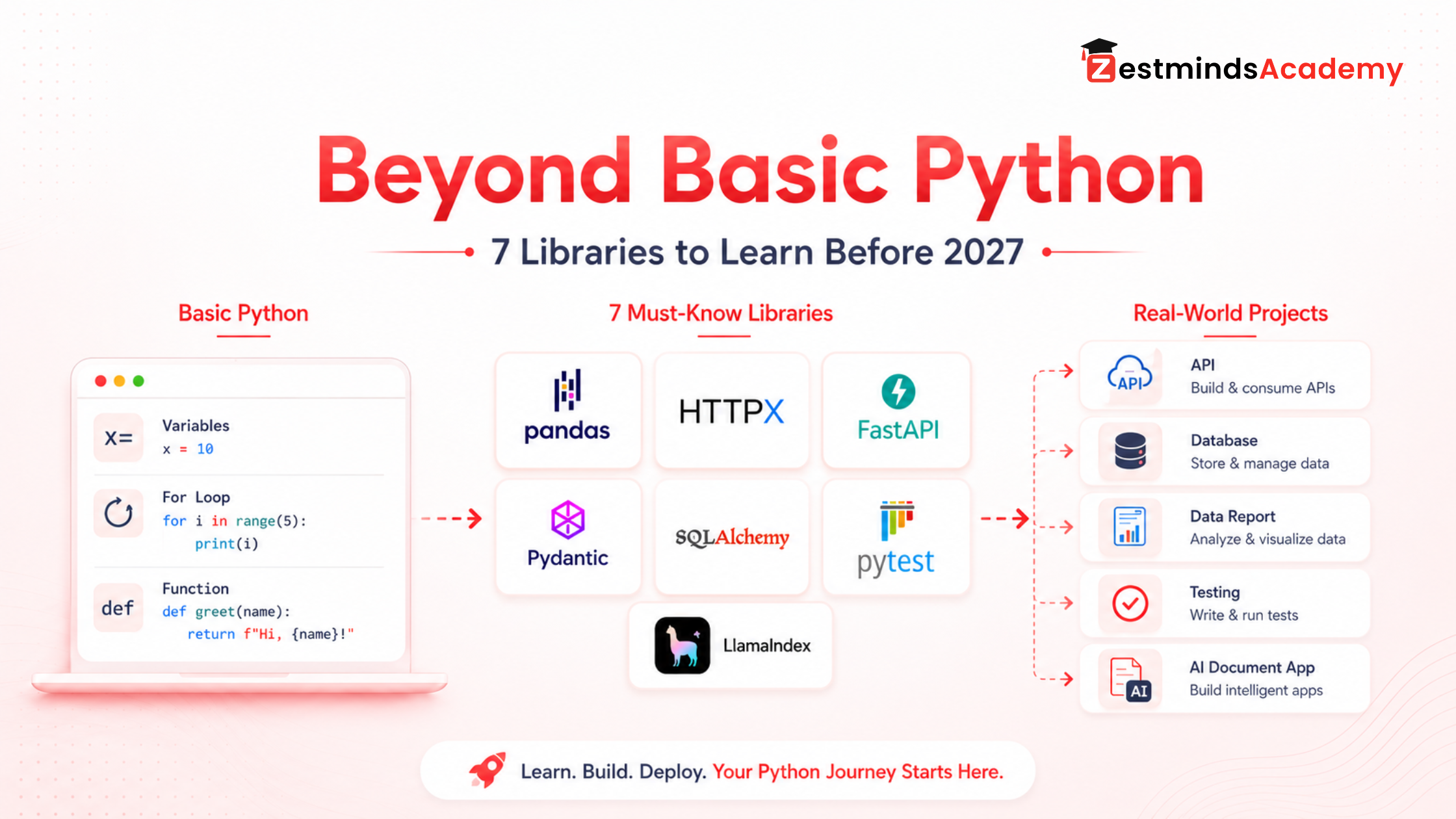
- APIs
- Django or Flask basics
- Automation basics
- Web scraping basics
- Data analytics basics
- AI/ML introduction where suitable
- Git and GitHub basics
- Project building
Python also has official documentation, tutorials, and beginner resources, which students can use for self-practice along with structured classroom learning. You can refer to the official Python documentation for additional learning support.
A simple way to understand this is:
Learning Python is not only about writing code that runs. It is about learning how to solve a problem step by step.
For example, a student should not only learn how to write a loop. They should also understand where loops are used in real work, such as reading data, processing records, checking conditions, or automating repeated tasks.
Project Examples Students Should Build While Learning Python
Projects are where real learning starts.
Many students understand concepts during class, but they struggle when asked to build something independently. That is normal. This is why projects are important.
Here are some useful Python project examples for beginners and freshers:
- Student management system
- Automation script
- Web scraping project
- API-based application
- Dashboard
- Mini CRM
- Data analysis project
- Basic Django or Flask web app
- File organizer tool
- Simple expense tracker
Why Projects Matter More Than Notes
Notes can help you revise, but projects help you prove your skills.
Projects help students:
- Understand real use cases
- Learn debugging
- Build confidence
- Add work to GitHub
- Explain their skills during interviews
- Understand how small pieces of code connect together
Many beginners feel confident in class but get stuck when they sit alone to build a project. That is why guided project practice matters.
A practical warning here:
Do not join a course where the only output is a certificate and no project work.
A certificate may support your profile, but projects show what you can actually do.
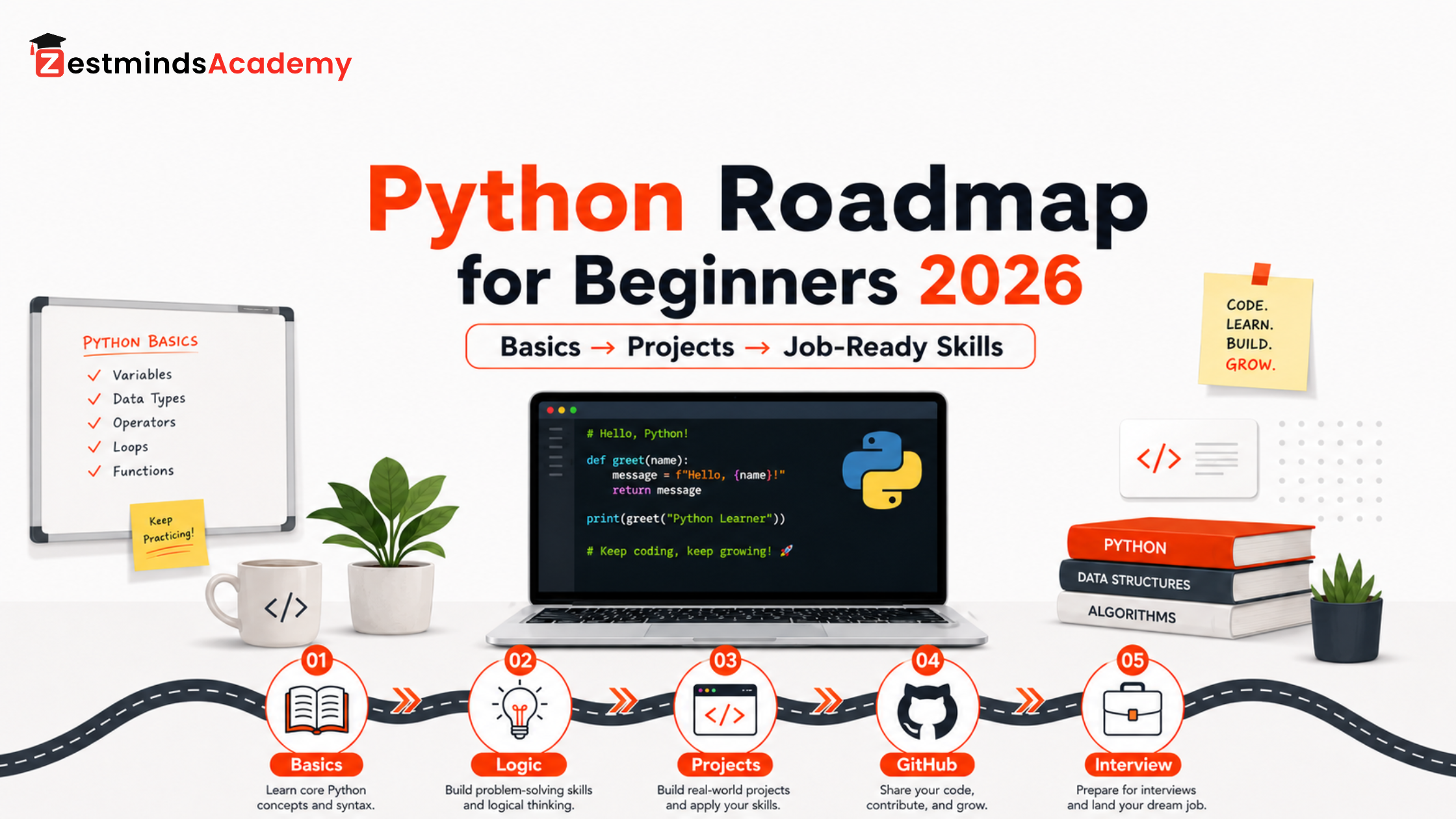
Students who are still confused about what to learn first can also read this Python roadmap for beginners.
Career Scope of Python for Students and Freshers
Python is useful because it connects with multiple career paths. It is used in backend development, automation, data analytics, data science, AI/ML foundations, scripting, and web development.
The Stack Overflow Developer Survey 2025 shows Python usage at 57.9% among all respondents and notes its continued relevance in AI, data science, and backend development.
For students and freshers, Python can support career directions such as:
- Python developer
- Backend developer
- Data analyst
- Automation developer
- Junior data science learner path
- AI/ML beginner path
- Full-stack developer with Python backend
But students should understand one thing clearly:
Python alone does not guarantee a job.
Career growth depends on:
- Practical skills
- Projects
- Problem-solving ability
- Database knowledge
- Communication skills
- Interview preparation
- Resume quality
- Consistent practice
In interviews, freshers are often asked to explain what they have built. A simple project explained clearly is more useful than only saying, “I know Python.”
So, Python can open doors, but students must build real capability around it.
Can Non-Technical Students Learn Python?
Yes, non-technical students can learn Python.
Python is often considered beginner-friendly because its syntax is easier to read compared to many other programming languages. But non-technical students should not rush.
A common mistake is jumping directly into AI, machine learning, or data science without learning basic programming logic.
A better learning path is:
- Learn basic Python syntax
- Practice small logic-building programs
- Understand functions and data structures
- Learn file handling and error handling
- Build small projects
- Learn database basics
- Explore APIs, Django/Flask, data analytics, or AI/ML depending on interest
For non-technical students and career switchers, the first goal should be confidence with logic. Advanced topics can come later.
Why Practical Learning Matters More Than Theory-Only Training
Theory is important, but programming cannot be learned only by reading notes.
Students need to write code, make mistakes, fix errors, and build small projects again and again.
A practical Python course should help students:
- Write code regularly
- Solve errors
- Build projects
- Understand GitHub
- Work with databases
- Learn how APIs work
- Practice explaining projects
- Prepare for interviews gradually
Programming confidence comes when students build, break, debug, and improve real projects.
This is also where the training environment matters.
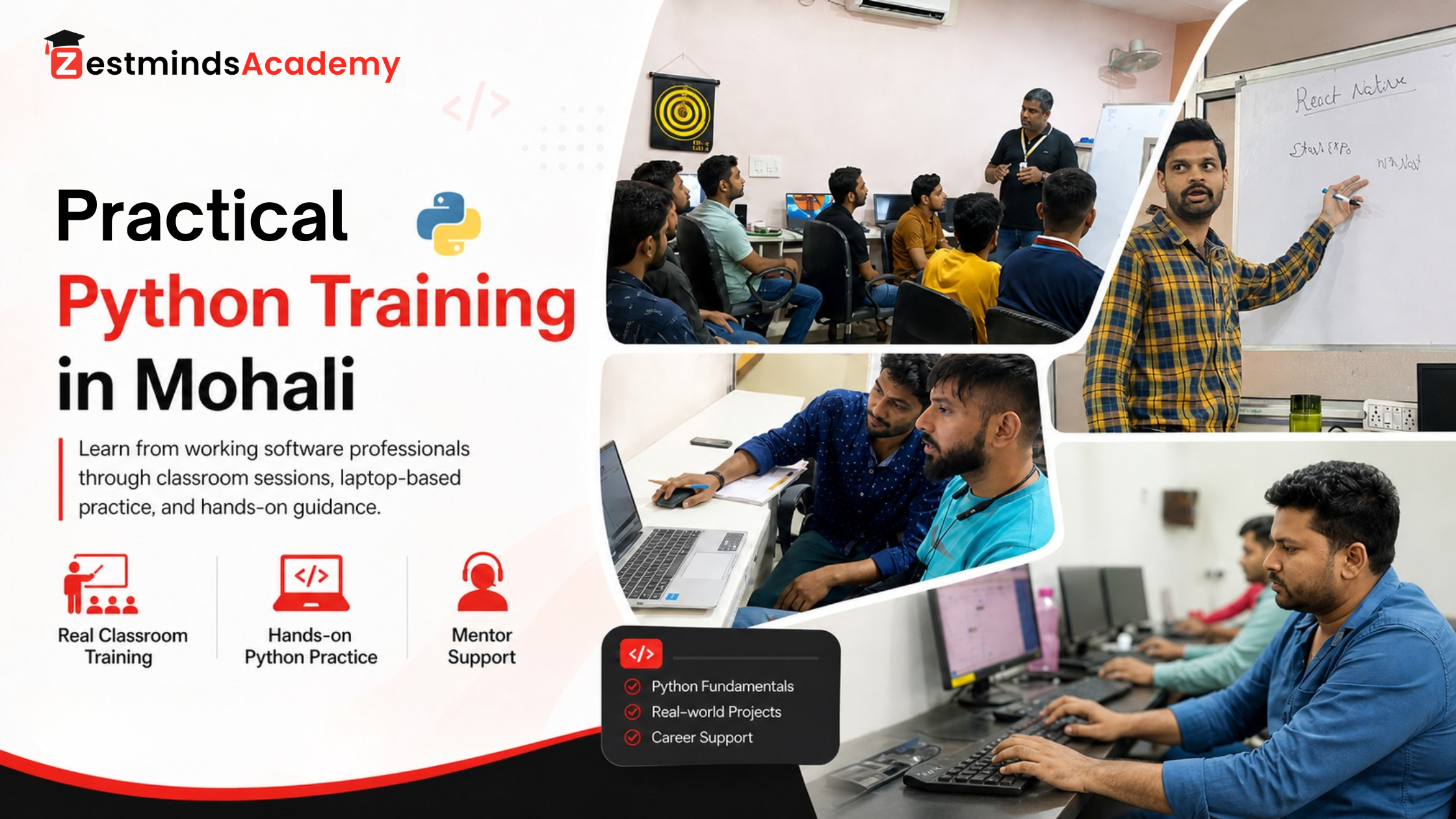
At Zestminds Academy, Python training is guided by working software professionals. The focus is on practical learning, project-based practice, doubt sessions, and career support instead of only theory-based teaching.
Support may include:
- Resume guidance
- GitHub profile guidance
- Interview preparation
- Mock interview practice
- Project explanation practice
- LinkedIn profile guidance
This matters because many freshers know basic concepts but struggle to explain their project in interviews. Practical training should prepare students for that stage as well.
Quick Checklist Before Joining a Python Course
Before joining any Python course in Mohali or nearby areas, students and parents should check the course carefully.
Use this simple checklist:
- Does the course include practical projects?
- Who teaches the course?
- Are trainers working professionals or only theory instructors?
- Is there regular doubt support?
- Does the course include SQL and database basics?
- Are APIs or frameworks introduced?
- Will students build GitHub-ready projects?
- Is resume guidance included?
- Is interview preparation included?
- Are placement claims realistic?
- Is the fee clearly explained?
- Is the batch format suitable?
- Are weekday or weekend batches available?
- Is offline, online, or hybrid learning available?
- Is the institute reachable from Mohali, Chandigarh, Kharar, Zirakpur, or Panchkula?
Parents should not judge a course only by certificate or fee. They should ask what practical work the student will complete during training.
Be careful with any course that promises guaranteed jobs without clearly explaining the curriculum, projects, trainer background, and support process.
A good course should not only say “placement support”. It should explain how students are prepared through projects, resume building, mock interviews, and technical practice.
About Zestminds Academy’s Python Training in Mohali
Zestminds Academy offers Python training for beginners, students, freshers, non-technical learners, and career switchers.
The Python training fee is ₹4,000 per month.
Students can choose from:
- 3-month Python training
- 6-month Python training
- Internship-based training
Batch timings may include:
- Morning batch: 9:00 AM to 12:00 PM
- Afternoon batch: 1:00 PM to 4:00 PM
- Small batch learning
- Doubt sessions
The training is guided by working software professionals, with a focus on practical learning, project work, and career preparation.
Students can explore the full course details here:
They can also check real learning experiences here:
Final Thoughts: Compare Value, Not Only Fees
Python course fees are important, but they should not be the only factor in your decision.
Before joining a Python course, check what you will actually learn, how much you will practice, what projects you will build, and whether you will get proper guidance for interviews and career preparation.
For students in Mohali, Chandigarh, Kharar, Zirakpur, and Panchkula, the right Python course should help you move from basic understanding to practical confidence.
Start with this question:
“After this course, will I be able to build and explain real projects?”
If the answer is yes, the course is more likely to be useful.
To take the next step, you can explore Zestminds Academy’s Python Training program and understand the course structure, duration options, practical projects, and batch availability.
FAQs
What is the fee for Python course in Mohali?
Python course fees in Mohali vary depending on duration, curriculum, trainer experience, projects, and career support. At Zestminds Academy, Python training fee is ₹4,000 per month.
How much can a 3-month or 6-month Python course cost at Zestminds Academy?
At ₹4,000 per month, a 3-month Python course may roughly cost ₹12,000, and a 6-month course may roughly cost ₹24,000, depending on the final training plan. Students should confirm the latest fee and batch details before admission.
Can I learn Python in 3 months?
Yes, a beginner can learn Python fundamentals in 3 months with regular practice. But for career readiness, students should also build projects, practice debugging, understand databases, and prepare for interviews.
What is the duration of Python training at Zestminds Academy?
Zestminds Academy offers 3-month, 6-month, and internship-based Python training options. The right duration depends on the student’s current level and career goal.
Is Python good for beginners?
Yes, Python is beginner-friendly and commonly used for programming, backend development, automation, data analytics, and AI/ML foundations.
Can non-technical students learn Python?
Yes, non-technical students can learn Python. They should start with basic programming logic, simple syntax, small tasks, and guided practice before moving to advanced topics.
What projects should I build while learning Python?
Good beginner Python projects include a student management system, automation script, web scraping project, API-based app, dashboard, mini CRM, data analysis project, and basic Django/Flask web app.
What is the career scope of Python?
Python can support career paths in backend development, automation, data analytics, data science learning, AI/ML foundations, and web development. Career growth depends on skills, projects, interview preparation, and consistent practice.
Is 6 months better than 3 months for Python training?
A 3-month course is useful for fundamentals. A 6-month course is better for students who need deeper practice, larger projects, database/API exposure, frameworks, and interview preparation.
What should I check before joining a Python course?
Check the curriculum, trainer background, project work, doubt support, batch size, database/API coverage, career guidance, resume support, GitHub guidance, and whether placement claims are realistic.
Table of Contents
- Python Course Fees in Mohali
- What Affects Python Course Fees?
- Python Course Duration: 3 Months vs 6 Months vs Internship-Based Training
- Is 3 Months Enough to Learn Python?
- Who Should Choose a 6-Month Python Program?
- What Should Be Included in a Practical Python Course?
- Project Examples Students Should Build While Learning Python
- Career Scope of Python for Students and Freshers
- Can Non-Technical Students Learn Python?
- Why Practical Learning Matters More Than Theory-Only Training
- Quick Checklist Before Joining a Python Course
- About Zestminds Academy’s Python Training in Mohali
- Final Thoughts
- FAQs
Rajat Sharma
Stay Ahead with Expert Insights & Trends
Explore industry trends, expert analysis, and actionable strategies to drive success in AI, software development, and digital transformation.
Begin Your Journey to a Successful Tech Career
Talk to our mentors and choose the right training program.
Call us: +91-9056277961
Email us: hello@zestmindsacademy.com