Python Roadmap for Beginners 2026: Step-by-Step Path to Job-Ready Skills
Python is still one of the best first programming languages for students, freshers, beginners, and working professionals who want to enter the tech industry with practical skills.
This Python roadmap for beginners 2026 explains what to learn first, how to practise, which projects to build, and how to move toward job-ready confidence without getting lost in random tutorials.

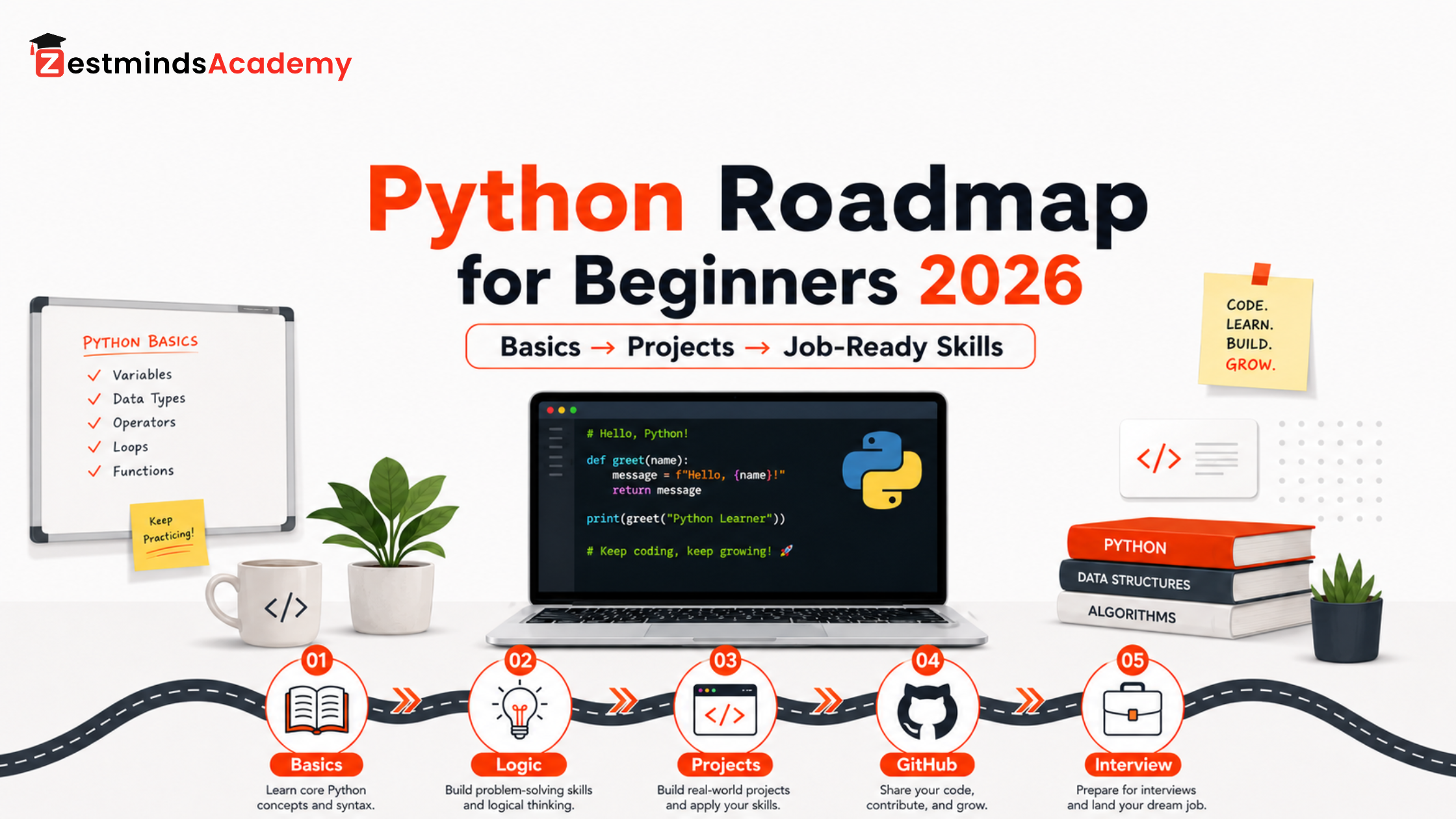
Quick Answer: What Should Beginners Learn First in Python?
If you are starting Python in 2026, do not begin with AI tools, advanced libraries, or frameworks. Start with programming basics, Python fundamentals, logic building, core Python concepts, developer tools, beginner projects, and then choose one direction such as backend development, automation, data analytics, or AI integration.
A good Python roadmap for beginners 2026 should help you move in this order:
- Understand how programming works.
- Learn Python basics like variables, data types, conditions, loops, and functions.
- Practise logic-building questions regularly.
- Learn lists, dictionaries, file handling, modules, errors, and OOP basics.
- Use tools like VS Code, pip, virtual environments, Git, and GitHub.
- Build beginner projects that show real understanding.
- Choose one practical career path after your basics are stable.
- Prepare for interviews by explaining your code and projects clearly.
The goal is not to finish Python quickly. The real goal is to become comfortable enough to solve problems, build small applications, and explain your work with confidence.
Need help choosing the right Python path?
If you are a student, fresher, or career switcher from Mohali, Chandigarh, or nearby areas, you can discuss your current level with a Zestminds Academy mentor and get a practical learning direction.
Python Roadmap for Beginners 2026 at a Glance
Before going deep into each stage, here is the complete roadmap in a simple table. This will help you understand what to learn, what to practise, and what outcome you should expect from each stage.
| Stage | What to Learn | What to Practise | Expected Outcome |
|---|---|---|---|
| Stage 1 | Programming basics | Input, output, logic flow, simple instructions | You understand how programs work |
| Stage 2 | Python fundamentals | Variables, data types, operators, conditions, loops, functions | You can write small Python programs |
| Stage 3 | Logic building | Number problems, strings, lists, patterns, conditions | You start thinking like a programmer |
| Stage 4 | Core Python | Lists, tuples, sets, dictionaries, modules, file handling, exceptions, OOP | You can structure code better |
| Stage 5 | Developer tools | VS Code, pip, virtual environment, Git, GitHub | You start working like a real developer |
| Stage 6 | Beginner projects | Calculator, expense tracker, contact book, API project | You build proof of learning |
| Stage 7 | Career direction | Backend, automation, data analytics, AI, testing, or full-stack path | You know what to learn next |
| Stage 8 | Job readiness | Interview questions, project explanation, GitHub, resume projects | You become more confident for internships and fresher roles |
Step-by-Step Python Learning Order for Beginners
A beginner Python roadmap should feel clear, not confusing. You do not need to learn everything at once. You need to learn the right things in the right order.
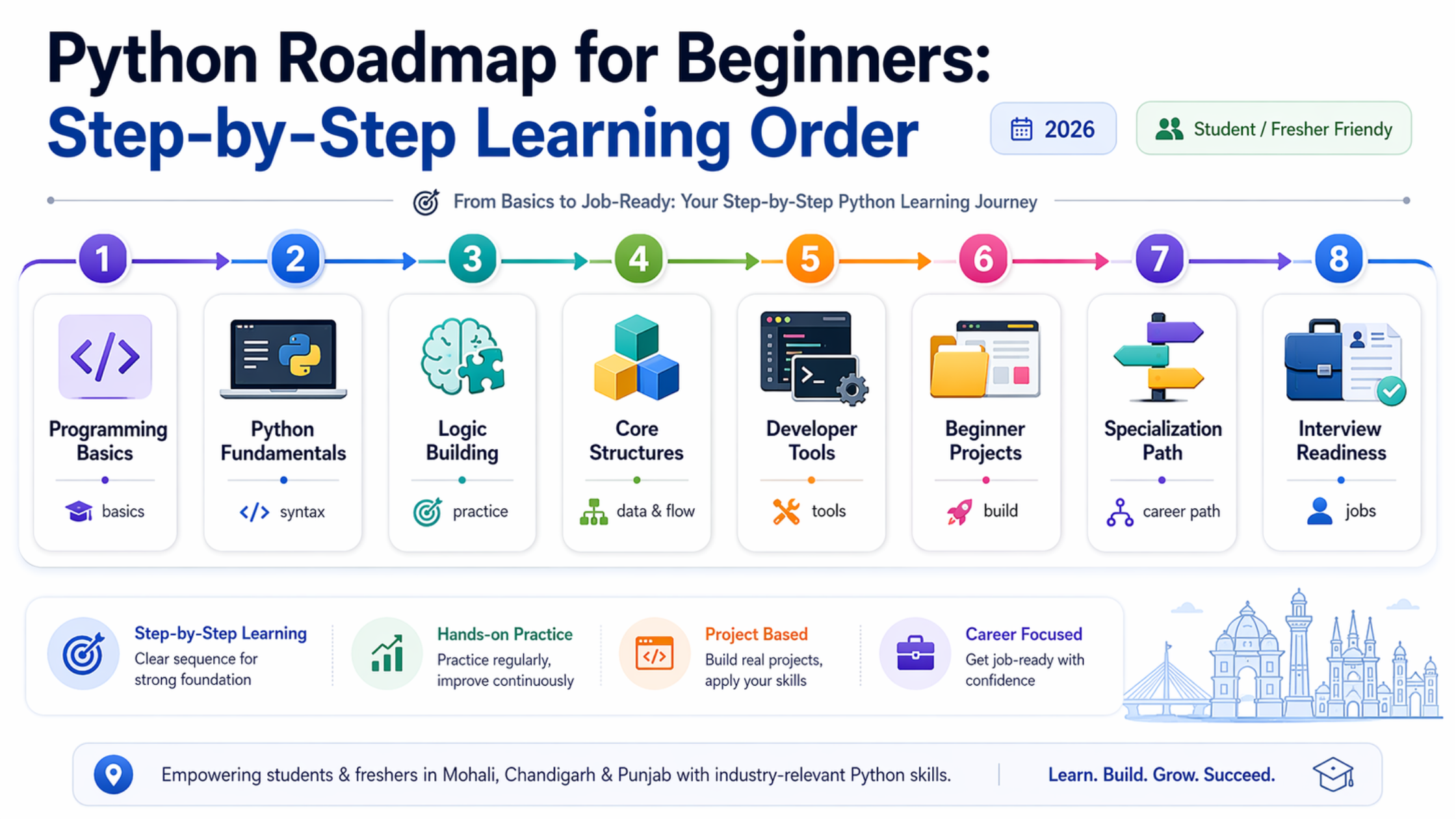
Step 1: Understand How Programming Works
Before Python syntax, understand the basic idea of programming. A program takes input, applies logic, and produces output. This simple model helps beginners stop treating code like something mysterious.
For example, a student marks program may take marks as input, check conditions, calculate total or percentage, and show the result. Almost every beginner program follows this type of thinking.
Step 2: Learn Python Fundamentals
Start with variables, data types, operators, input and output, conditions, loops, and functions. These are the building blocks you will use again and again in every project.
Do not rush this stage. Many beginners say they know Python basics, but they struggle when asked to write a simple program without watching a tutorial. Your goal at this stage is independent comfort.
Practise examples like:
- Take two numbers and print the larger one.
- Check whether a number is even or odd.
- Calculate student marks and grade.
- Print a multiplication table using loops.
- Create a function to calculate simple interest.
Step 3: Build Logic and Problem-Solving Habits
After basics, start solving small problems regularly. Logic building is where many learners become stuck because they watch too much and practise too little.
Start with simple questions. Count vowels in a string. Reverse a number. Find the largest number in a list. Check whether a word is a palindrome. These small exercises train your mind to break problems into steps.
This is one of the most important parts of any beginner Python roadmap because job readiness is not built only by knowing syntax. It is built by solving problems.
Step 4: Learn Core Python Properly
Once the basics are steady, move into lists, tuples, sets, dictionaries, modules, file handling, exception handling, and object-oriented programming basics.
You do not need advanced theory first. You need practical understanding. For example, you should know when a list is useful, when a dictionary is better, how to save data in a file, and why functions make your code easier to manage.
Step 5: Use Developer Tools Like VS Code, Git, and GitHub
This stage is often ignored by beginners, but it matters for job readiness. Learn how to write code in VS Code, install packages with pip, use virtual environments, organize files, and upload projects to GitHub.
Even if your first project is small, GitHub helps you build a visible learning record. It also teaches you to manage your code like a developer instead of keeping everything in random files.
Step 6: Build Beginner Python Projects
Projects turn theory into proof. A calculator, number guessing game, to-do list, student marks manager, contact book, expense tracker, or simple API-based weather app can help you move from “I understand the topic” to “I can build something.”
For freshers, this matters because interviews often become easier when you can explain what you built, what logic you used, and what problem you solved.
Step 7: Choose One Career Direction
After Python basics, do not try to learn backend, AI, data science, automation, testing, and full-stack development all at once. Choose one direction based on your interest and career goal.
If you like application development, explore Flask, Django, APIs, and databases. If you like data, explore Excel, SQL, pandas, and data analytics. If you like modern AI work, build a strong Python base first and then move into APIs, automation, and AI integration.
Step 8: Prepare for Interviews and Job Readiness
Once you can code and build projects, start preparing for interviews. Learn how to explain your project, write a clean README, answer basic Python questions, and solve beginner logic problems without panic.
Employers and trainers do not only notice what you know. They notice how clearly you think, how you debug, and how well you explain your work.
Want a structured classroom path?
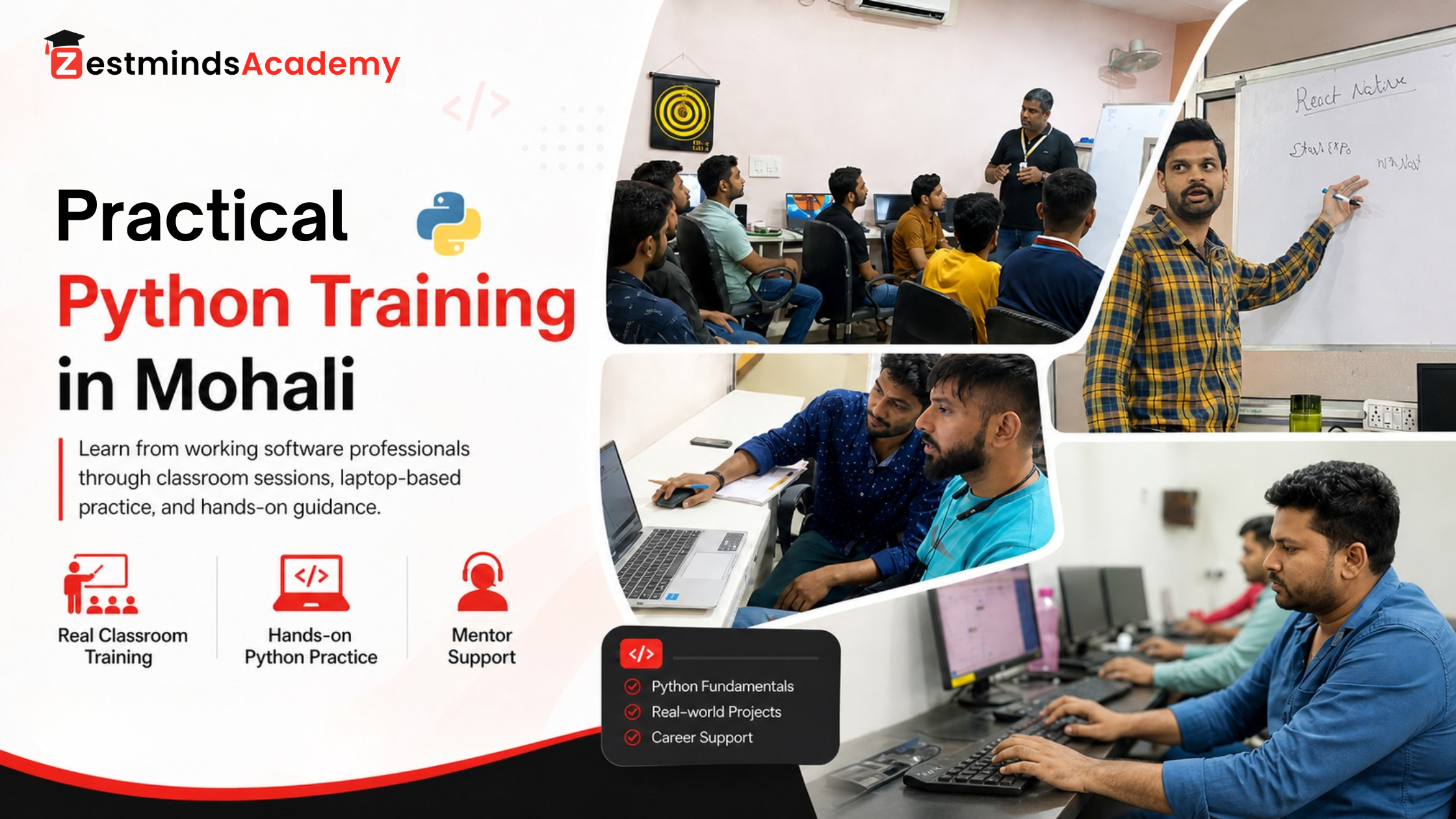
Explore practical Python training in Mohali with coding practice, assignments, mentor support, and project-style learning at Zestminds Academy.
30/60/90-Day Python Learning Plan for Beginners
Every learner has a different speed, but a 30/60/90-day plan gives beginners a realistic direction. This is not a guarantee that everyone becomes job-ready in 90 days. It is a practical structure to help you stay consistent.
| Timeline | Focus Area | Practice Work | Goal |
|---|---|---|---|
| First 30 Days | Python basics and logic | Variables, conditions, loops, functions, strings, lists, beginner problems | Write small programs independently |
| Days 31–60 | Core Python and tools | Dictionaries, file handling, errors, modules, OOP basics, VS Code, GitHub | Structure code and manage small projects |
| Days 61–90 | Projects and career direction | Expense tracker, contact book, API project, README, interview basics | Build portfolio confidence and choose next path |
If you are joining a short-duration program, such as 45 days Python training in Mohali, the goal should be practical confidence through assignments, coding tasks, file handling, OOP exposure, debugging, and project-style exercises. A short program should not promise unrealistic outcomes, but it can give beginners strong direction and discipline.
Who Should Follow This Python Roadmap?
This roadmap is useful for anyone who wants a practical entry into programming. Python is beginner-friendly, but that does not mean learning should be casual. You still need structure, practice, and feedback.
Students
College students can use Python as a strong starting point for software development, data analytics, automation, and AI-related learning. It is especially useful for BCA, MCA, B.Tech, B.Sc IT, and other students who want a practical skill beyond theory.
Freshers
Freshers need more than course completion. They need projects, GitHub, interview confidence, and the ability to explain their code. A clear Python roadmap for freshers helps connect learning with employability.
Non-Tech Learners
Students from B.Com, BBA, mechanical, life sciences, or other non-CS backgrounds can also start with Python. Its syntax is easier to read, and it allows beginners to build confidence before moving into deeper development or data paths.
Working Professionals
Working professionals can use Python for automation, reporting, backend basics, testing, scripting, and data handling. A manual tester can move toward automation. A support engineer can learn scripting. A business or operations professional can use Python for workflow automation.
For learners in Mohali, Chandigarh, Kharar, Zirakpur, Panchkula, Punjab, Haryana, and Himachal, Python can be a practical first step if the learning path includes regular coding, doubt support, and project-based practice.
What to Learn After Python Basics
One of the most common beginner questions is: what should I learn after Python basics?
The answer depends on your goal. If your goal is job-ready confidence, the next stage should not be random. It should build practical value.
| Goal | What to Learn Next | Best For | Outcome |
|---|---|---|---|
| Software development | OOP, file handling, APIs, databases, Flask or Django | Learners interested in backend or web development | Clear transition from Python basics to application development |
| Fresher employability | Problem-solving, GitHub projects, debugging, clean code | Students and freshers | Stronger portfolio and interview readiness |
| Data analytics | Excel, SQL, pandas, NumPy, charts, reports | Learners interested in data roles | Better understanding of data workflows |
| AI and automation | APIs, automation scripts, data handling, AI integration basics | Beginners exploring modern AI use cases | Controlled path toward automation and AI projects |
If you want to move toward data roles, explore Data Analytics training or Data Science training after your Python fundamentals are stable.
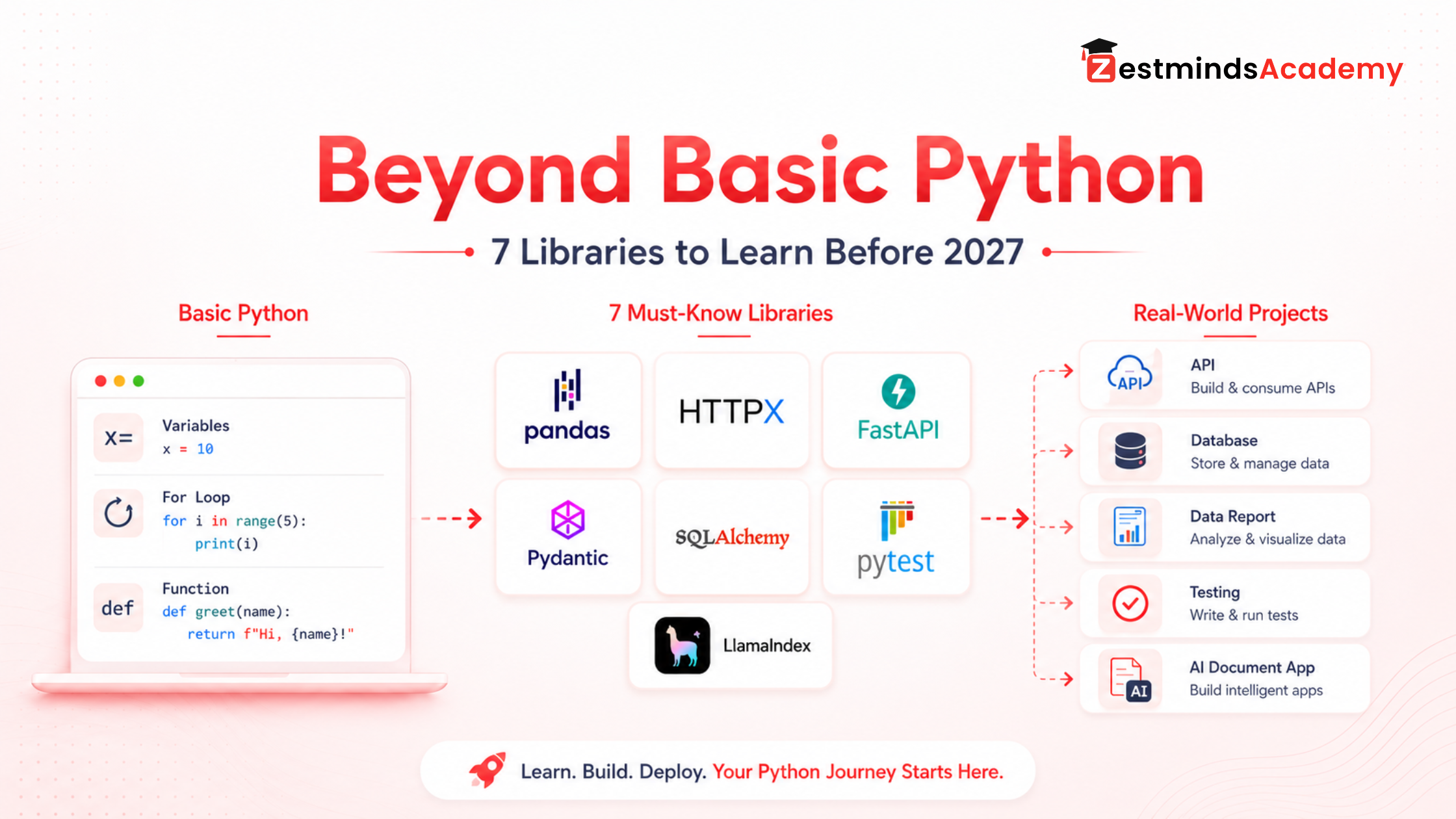
If you want to move toward modern AI use cases, first become comfortable writing Python programs on your own. Then you can explore AI and LLM training, APIs, automation workflows, and AI integration with better control.
What Beginners Should Not Learn Too Early
A good roadmap tells you what to learn, but it also tells you what to avoid in the beginning.
Do not rush into advanced frameworks, machine learning models, AI agents, complex web apps, or too many libraries before your Python base is stable. These topics are useful, but they become frustrating if you cannot write basic logic, functions, and file-handling programs independently.
As a beginner, avoid these mistakes:
- Do not jump to Django or Flask before understanding functions and data structures.
- Do not start AI projects before learning APIs, files, and basic data handling.
- Do not copy projects without understanding the logic.
- Do not learn ten libraries without building one complete small project.
- Do not measure progress by hours watched. Measure it by programs built.
The best way to learn Python in 2026 is to build depth first, then speed.
Beginner Python Projects That Build Real Confidence
If you want to become job-ready, projects are not optional. They help you prove that you can apply what you learned.
| Project Idea | What You Practise | Difficulty | Portfolio Value |
|---|---|---|---|
| Calculator | Functions, inputs, conditions | Easy | Good first project |
| Number guessing game | Loops, random numbers, logic | Easy | Shows control-flow understanding |
| Student marks manager | Lists, dictionaries, calculations | Easy to medium | Good for college learners |
| Expense tracker | Data handling, calculations, file storage | Medium | Strong real-life relevance |
| Contact book | File handling, search, update, delete | Medium | Shows practical app thinking |
| Weather app using API | APIs, requests, response handling | Medium | Good interview discussion point |
| Beginner backend app | Routes, forms, CRUD, database basics | Advanced beginner | Useful for development path |
Do not build ten unfinished projects. Build four or five projects that show progression. For example:
- Project 1: Calculator
- Project 2: Student marks manager
- Project 3: File-based expense tracker
- Project 4: API-based weather app
- Project 5: Beginner backend app
This progression tells a better story than a random list of copied projects. It shows that you are growing step by step.
How to Present Your Python Projects
A project is not complete just because the code runs. Add a simple README file. Mention what the project does, what features it has, what concepts you used, and how someone can run it.
For freshers, this is very useful because interviewers may ask:
- Why did you build this project?
- What problem does it solve?
- Which Python concepts did you use?
- What errors did you face?
- What would you improve next?
Want to build Python projects with trainer guidance?
Zestminds Academy focuses on practical coding, assignments, debugging support, and project-style exposure so beginners can move beyond theory.
Job-Ready Python Skills Checklist for Freshers
Python alone does not make you job-ready. You become job-ready when you can apply Python, explain your logic, build projects, and show learning discipline.
| Skill Area | What You Should Be Able to Do | Why It Matters |
|---|---|---|
| Python basics | Write programs using variables, conditions, loops, and functions | Shows foundation clarity |
| Problem-solving | Break a problem into steps and solve it logically | Important for interviews |
| Core Python | Use lists, dictionaries, files, exceptions, and modules | Needed for practical programs |
| Debugging | Read error messages and fix mistakes calmly | Shows real coding maturity |
| Projects | Build and explain 3–5 beginner projects | Creates proof of learning |
| GitHub | Upload code and write simple README files | Improves portfolio visibility |
| Communication | Explain what your project does and how you built it | Helps in interviews and reviews |
If you can do these things with confidence, you are not just “learning Python.” You are moving toward practical employability.
Common Mistakes Beginners Make While Learning Python
Most beginners do not struggle because Python is impossible. They struggle because their learning approach becomes scattered.
Mistake 1: Starting Without a Roadmap
Random videos, notes, and course clips can create confusion. A roadmap helps you know what to learn now and what to ignore for later.
Mistake 2: Watching Too Much and Coding Too Little
Everything feels easy while watching a video. Real learning starts when you write code without seeing the answer first.
Mistake 3: Jumping to Advanced Topics Too Early
Web development, AI, automation, and data science are useful paths, but they become difficult if your basics are weak.
Mistake 4: Avoiding Errors
Errors are not proof that you are bad at coding. They are part of the process. Learn to read error messages and fix one issue at a time.
Mistake 5: Not Building Projects
Completing theory modules is not enough. Projects reveal whether you can apply what you learned.
Mistake 6: Ignoring Interview Readiness
If your goal is internship or job preparation, include interview questions, GitHub, README writing, and project explanation in your roadmap.
How to Choose the Right Python Training Path in Mohali or Chandigarh
Some learners do well with self-study. Others need structure, mentor feedback, doubt support, and regular assignments. The right choice depends on your background, discipline, and current confidence level.
If you are exploring a Python training institute in Mohali for beginners or comparing options near Chandigarh, do not judge only by promises. Check how the learning is actually designed.
| Decision Factor | What to Check | Why It Matters |
|---|---|---|
| Roadmap-based curriculum | Basics to projects to interview preparation | Prevents scattered learning |
| Beginner support | Doubt handling, revision, simple explanations | Builds confidence for students and freshers |
| Practical assignments | Regular coding tasks and feedback | Turns theory into skill |
| Project-style exposure | Small apps, file handling, APIs, GitHub | Improves portfolio and interview discussion |
| Career guidance | Direction after Python basics | Helps learners choose backend, data, AI, or automation path |
| Honest expectations | No unrealistic job guarantees | Builds trust and serious learning discipline |
At Zestminds Academy, the focus is practical classroom training, mentor-led learning, coding practice, assignments, and project-style exposure. The aim is to help students learn by doing, not only by listening.
For learners from Mohali, Chandigarh, Kharar, Zirakpur, Panchkula, Punjab, Haryana, and Himachal, local classroom support can help with consistency, doubt resolution, and guided practice.
Final Advice: Learn Python in the Right Order
Python can be your first serious skill in tech, but only if you learn it with the right mindset. Do not chase everything at once. Build your foundation first, practise logic, learn core Python, use developer tools, build projects, and then choose one career direction.
If you are a student or fresher, your first goal should not be to look advanced. Your first goal should be to become consistent, practical, and confident.
The right Python roadmap gives you clarity. Your practice gives you skill. Your projects give you proof. Your guidance gives you direction.
Ready to start your Python learning journey?
Book Free Career Counselling session with Zestminds Academy and understand the right Python learning path based on your current level, background, and career goal.
FAQs
What is the best Python roadmap for beginners in 2026?
The best Python roadmap for beginners in 2026 starts with programming basics, then moves into Python fundamentals, logic building, core Python, developer tools, beginner projects, career direction, and interview readiness.
What should I learn first in Python?
Start with variables, data types, operators, input and output, conditions, loops, and functions. These topics help you write small programs and understand how Python logic works.
Can I learn Python from scratch without a tech background?
Yes. Python is beginner-friendly and suitable for non-tech learners. With regular practice and a structured roadmap, students from non-CS backgrounds can also learn Python step by step.
How long does it take to learn Python for beginners?
Many beginners can understand the basics in a few weeks, but practical confidence usually takes a few months of consistent coding, assignments, projects, revision, and feedback.
What should I learn after Python basics?
After Python basics, learn problem-solving, file handling, OOP basics, modules, exceptions, Git, GitHub, and beginner projects. After that, choose a direction such as backend development, automation, data analytics, or AI integration.
Is Python good for freshers in 2026?
Yes. Python is a strong choice for freshers because it connects to backend development, automation, testing, data analytics, AI integration, and scripting. It becomes more valuable when combined with projects and interview preparation.
What Python projects should beginners build first?
Beginners can start with a calculator, number guessing game, student marks manager, to-do list, expense tracker, contact book, and API-based weather app. These projects help build logic and practical confidence.
What should beginners avoid while learning Python?
Beginners should avoid jumping into advanced frameworks, AI tools, machine learning, or too many libraries before learning Python basics, logic, functions, file handling, and core programming concepts properly.
Is a 3-month Python roadmap enough to start building projects?
Yes, a serious beginner can start building small projects within 3 months if they practise consistently. However, becoming job-ready also needs project review, debugging practice, GitHub, interview preparation, and clear career direction.
Do I need maths to learn Python?
You do not need advanced maths to start Python. For beginner programming, logical thinking, patience, and regular practice matter more than advanced mathematics.
Should I learn Python online or join classroom training?
Self-study works for disciplined learners. Classroom training can help students who need structure, doubt support, assignments, mentor feedback, project guidance, and accountability.
Is Python training in Mohali useful for beginners?
Python training in Mohali can be useful for beginners when the program includes practical coding, structured assignments, doubt support, project-style exposure, and honest career guidance.
Table of Contents
- Quick Answer
- Python Roadmap at a Glance
- Step-by-Step Python Learning Order
- 30/60/90-Day Python Learning Plan
- Who Should Follow This Roadmap?
- What to Learn After Python Basics
- What Not to Learn First
- Beginner Python Projects
- Job-Ready Skills Checklist
- Common Mistakes
- Training Path in Mohali or Chandigarh
- FAQs
Rajat Sharma
Stay Ahead with Expert Insights & Trends
Explore industry trends, expert analysis, and actionable strategies to drive success in AI, software development, and digital transformation.
Begin Your Journey to a Successful Tech Career
Talk to our mentors and choose the right training program.
Call us: +91-9056277961
Email us: hello@zestmindsacademy.com