AI Can Write MERN Code. But It Still Can’t Design Your Full-Stack Architecture.
AI tools can now generate MERN code very quickly.
Ask for a React form, and you may get it. Ask for an Express route, and it may generate one. Ask for a MongoDB schema, and it can suggest fields. Ask for login functionality, and it may even create frontend and backend code together.
That is useful.
But many students, freshers, career switchers, and even experienced developers face the same problem after using AI-generated code:
The code works for one or two features, but the project becomes confusing when it grows.
This problem is not only for beginners. Even developers who know MERN basics can struggle when a project moves beyond simple CRUD.
AI can help you write code. But it cannot automatically decide how your project should be structured, how your data should flow, where your logic should live, and how the application should grow.
In simple words:
AI can give you bricks. Architecture is knowing how to build the house.

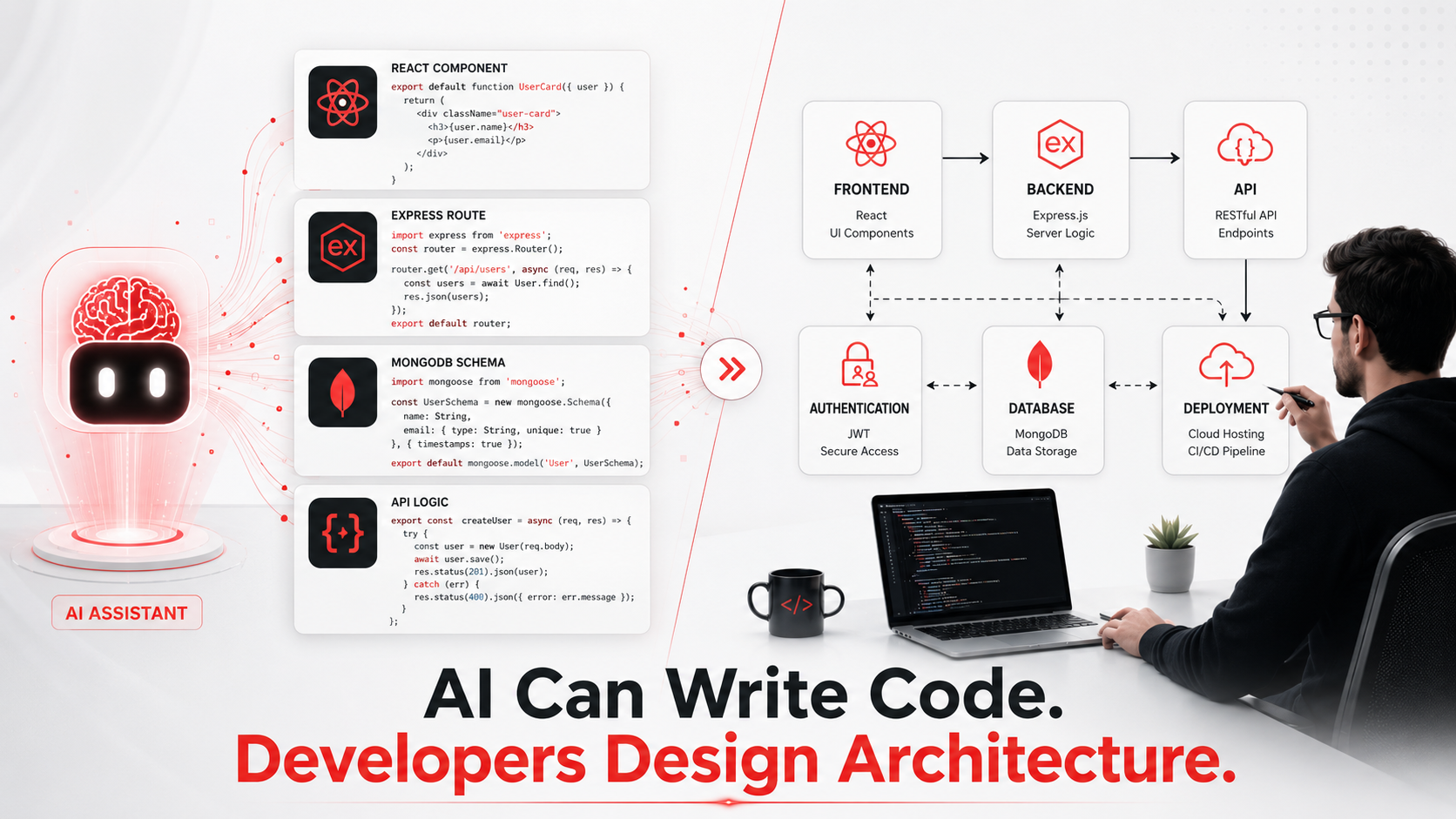
AI Has Made MERN Coding Faster, Not Automatically Better
AI can help MERN developers generate:
- React components
- Express routes
- MongoDB schemas
- CRUD APIs
- Authentication snippets
- Form validation
- Dashboard layouts
This saves time, especially when you already understand what you are building. But fast code is not always clean code.
A login API may work locally, but still have weak validation, poor error handling, or unclear role-based access. A React component may display correctly, but still become hard to reuse or debug later.
There is a big difference between code that runs and code that belongs in a real project.
In many training sessions, students are not stuck because they cannot write a button, form, or API. They are stuck because they do not understand how frontend, backend, database, APIs, authentication, and deployment work together.
That is not just a coding problem. That is an architecture problem.
The Real Problem Is Project Design
Code generation asks: “How can I write this?” Architecture asks: “Where should this live, and how will it grow?”
Architecture answers better questions:
- Where should this logic live?
- Should validation happen on frontend, backend, or both?
- How should the API response look?
- How will this feature work when more users are added?
- How will the database support future features?
- Can another developer understand this code later?
This is where many MERN projects become weak.
A developer may know React, Node.js, Express, and MongoDB separately. But real MERN development starts when you understand how these parts work together.
For example, AI can generate a login route. But you still need to decide:
- Where will token verification happen?
- How will protected routes work?
- How will roles like admin and user be handled?
- What error response should frontend receive?
- How will expired tokens be managed?
AI can generate pieces, but the developer must understand the system.
| AI Can Generate | Developer Must Decide |
|---|---|
| React form | Where form state, validation, and API handling should live |
| Express route | How routes, controllers, services, and middleware should be separated |
| MongoDB schema | How data relationships, indexes, and future queries should work |
| Login code | How authentication, authorization, token expiry, and protected routes should work |
What MERN Architecture Actually Means
MERN architecture is not just using MongoDB, Express, React, and Node.js in one project.
MongoDB’s official MERN stack explanation describes MERN as a stack made of MongoDB, Express.js, React.js, and Node.js, used together for full-stack JavaScript applications.
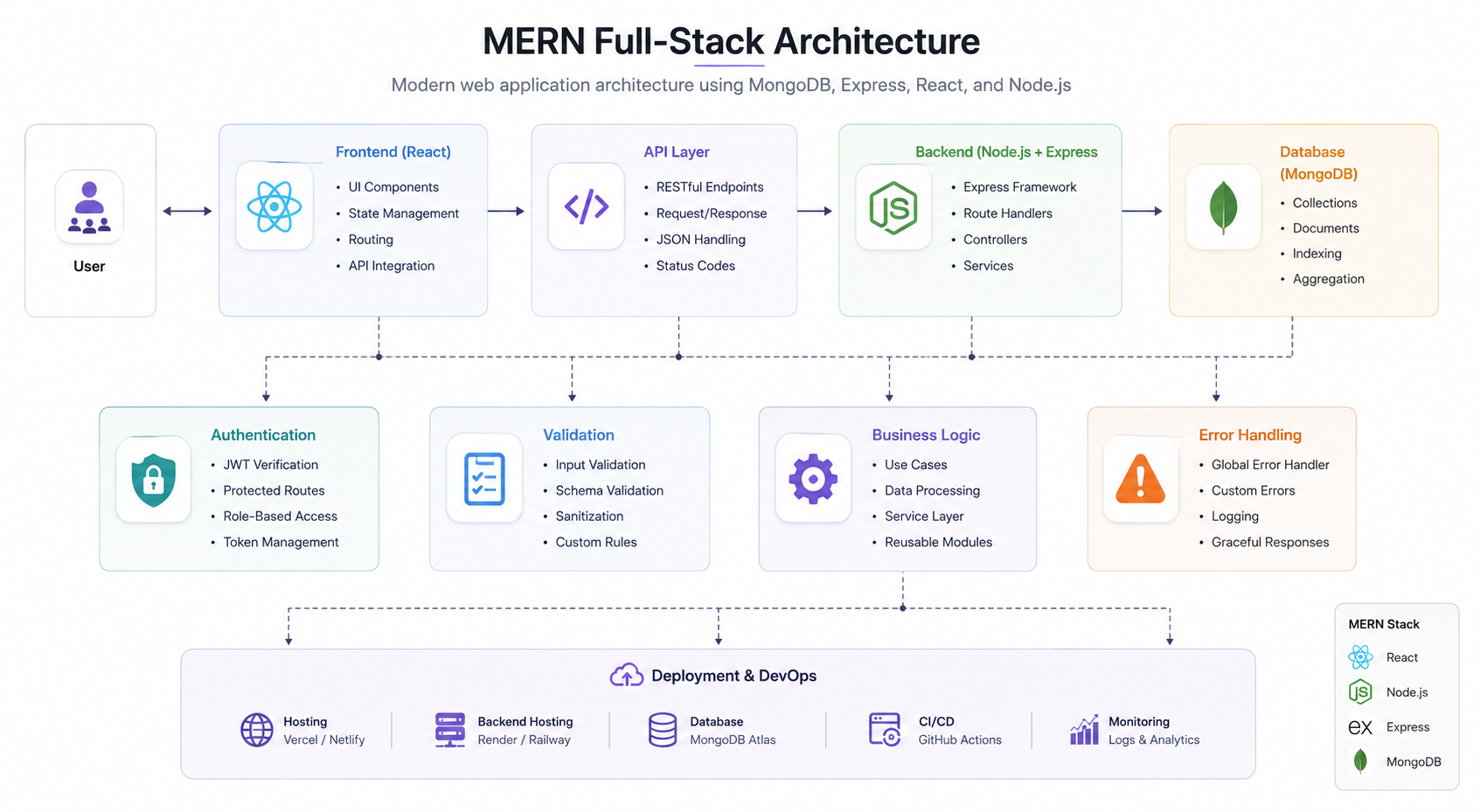
But in real development, architecture means understanding the role of each layer:
- React handles UI, components, forms, state, and user interaction.
- Node.js and Express handle backend logic, APIs, middleware, and request flow.
- MongoDB stores application data.
- APIs connect frontend actions with backend logic.
- Authentication, validation, error handling, and deployment connect the whole project into a usable system.
Many learners study React, Node, MongoDB, and Express separately. That is fine at the beginning, but real projects fail when these parts are not connected properly.
A frontend form depends on backend validation. Backend validation depends on database rules. Database structure affects API response. API response affects frontend state.
Everything is connected. That connection is architecture.
Where AI-Generated MERN Code Starts Breaking
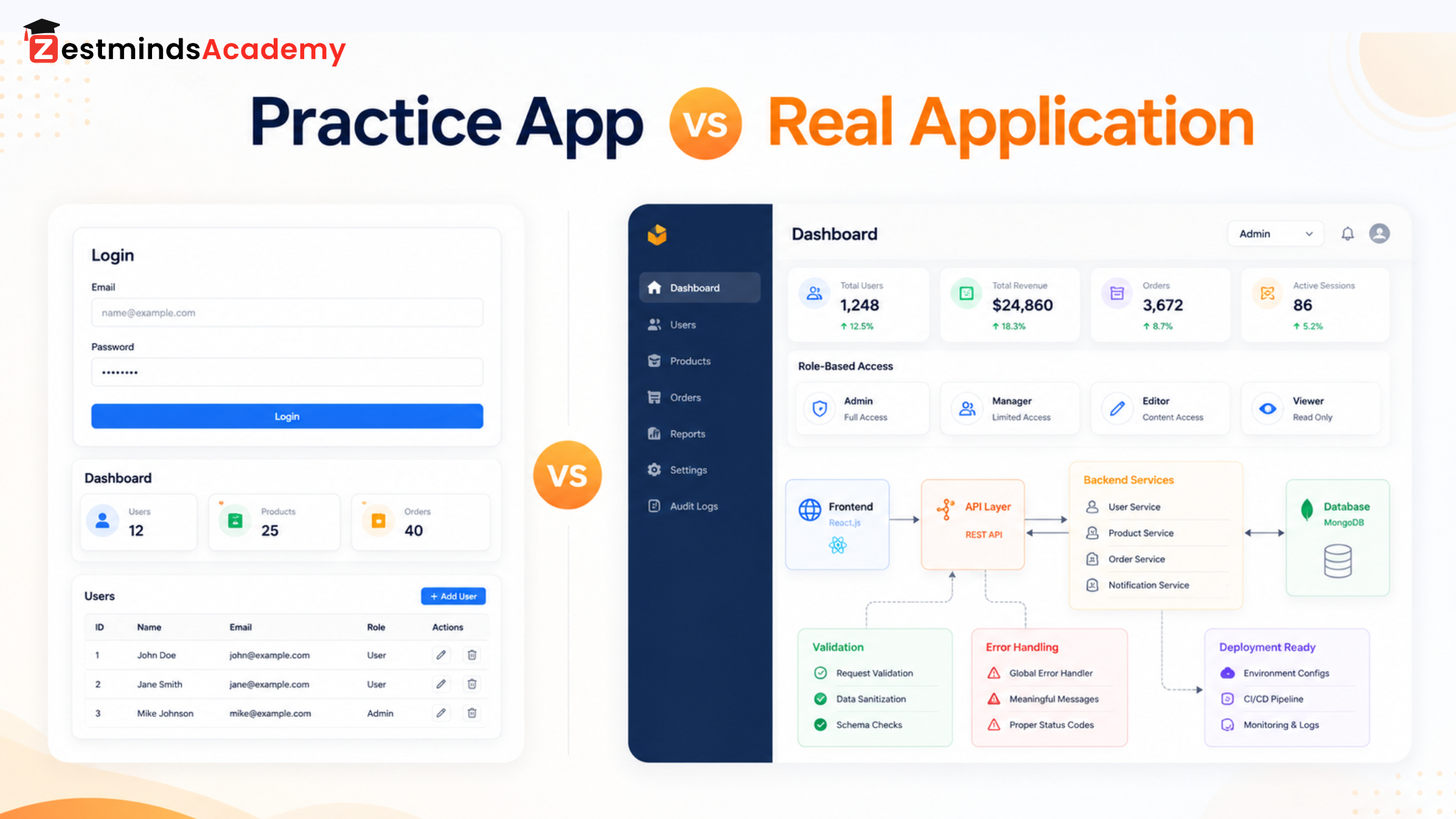
AI-generated code usually works well for small tasks. The problem starts when the project grows.
Imagine a simple job portal project.
At first, it has:
- User signup
- Login
- Job listing
- Apply button
This looks easy. Then the project grows:
- Employer dashboard
- Candidate profile
- Resume upload
- Saved jobs
- Application status
- Admin approval
- Search filters
- Notifications
- Role-based access
If the project was not structured properly, every new feature becomes harder.
Common mistakes include:
- Keeping all backend logic inside route files
- Writing too much logic inside React components
- Repeating API calls in multiple places
- Creating MongoDB collections without planning relationships
- Mixing validation, business logic, and database queries
- Using AI to fix errors without understanding the root cause
“I know MERN, but I still cannot build a proper project.”
The problem is usually not MERN. The problem is lack of project design.
Frontend and Backend Need Clear Structure
React is not just about making components.
A React component should have a clear responsibility. It should not become a place where everything is added randomly: API calls, form logic, filters, loading states, error handling, and role checks.
A common beginner mistake is creating one large dashboard component that handles everything. It works for some time, then it becomes hard to maintain.
The same happens on the backend.
Express makes it easy to create routes, but a real backend needs structure:
- Routes
- Controllers
- Services
- Middleware
- Validation
- Models
- Error handling
- Authentication
- Authorization
If every route directly handles validation, business logic, database queries, and response formatting, the backend becomes messy very quickly.
A common moment in training is when a student says:
“Code chal raha hai, but issue kahan se aa raha hai samajh nahi aa raha.”
That usually means the structure is not clear.
MongoDB Design Is More Than Creating Collections
MongoDB is flexible, but flexibility does not mean random structure.
AI can generate a Mongoose schema, but the developer still needs to decide:
- What data should be stored?
- What data should be referenced?
- What data should be embedded?
- Which fields will be searched often?
- How will relationships work?
- What happens when data grows?
For example, in an ecommerce-style MERN app, you may have users, products, orders, payments, carts, addresses, and reviews.
If these are not planned properly, the project becomes difficult later.
Should an order store only the product ID? Should it also store the product price at the time of purchase? If the product price changes later, should old orders change too?
That is not just a coding question. That is a data design question.
AI can suggest a schema, but the developer must understand the business logic behind it.
AI Can Help, But It Cannot Own Your Decisions
AI is useful when the developer already understands the direction.
Use AI for:
- Boilerplate code
- Error explanation
- Small refactoring
- Sample functions
- Test cases
- Code suggestions
But AI becomes risky when:
- You copy code without understanding
- You accept insecure code
- You ask vague prompts
- You generate disconnected files
- You cannot explain the final code
- You depend on AI for every error
Use AI as an assistant, not as the architect of your project.
AI can speed up a good developer. But it can confuse a learner who does not understand project structure.
What MERN Developers Should Learn Beyond CRUD
CRUD is only the beginning.
Completing create, read, update, and delete operations is a good milestone, but it does not mean you are ready for real application development.
After CRUD, focus on:
- Project structure
- API design
- Authentication and authorization
- Role-based access
- MongoDB data modeling
- React component structure
- Backend service structure
- Error handling
- Debugging
- Deployment basics
- Git workflow
- Reading and improving existing code
You do not need to learn everything in one week. But you should stop measuring progress only by how many tutorials you complete.
Can I build one project properly, explain every major decision, debug errors, and improve the structure when requirements change?
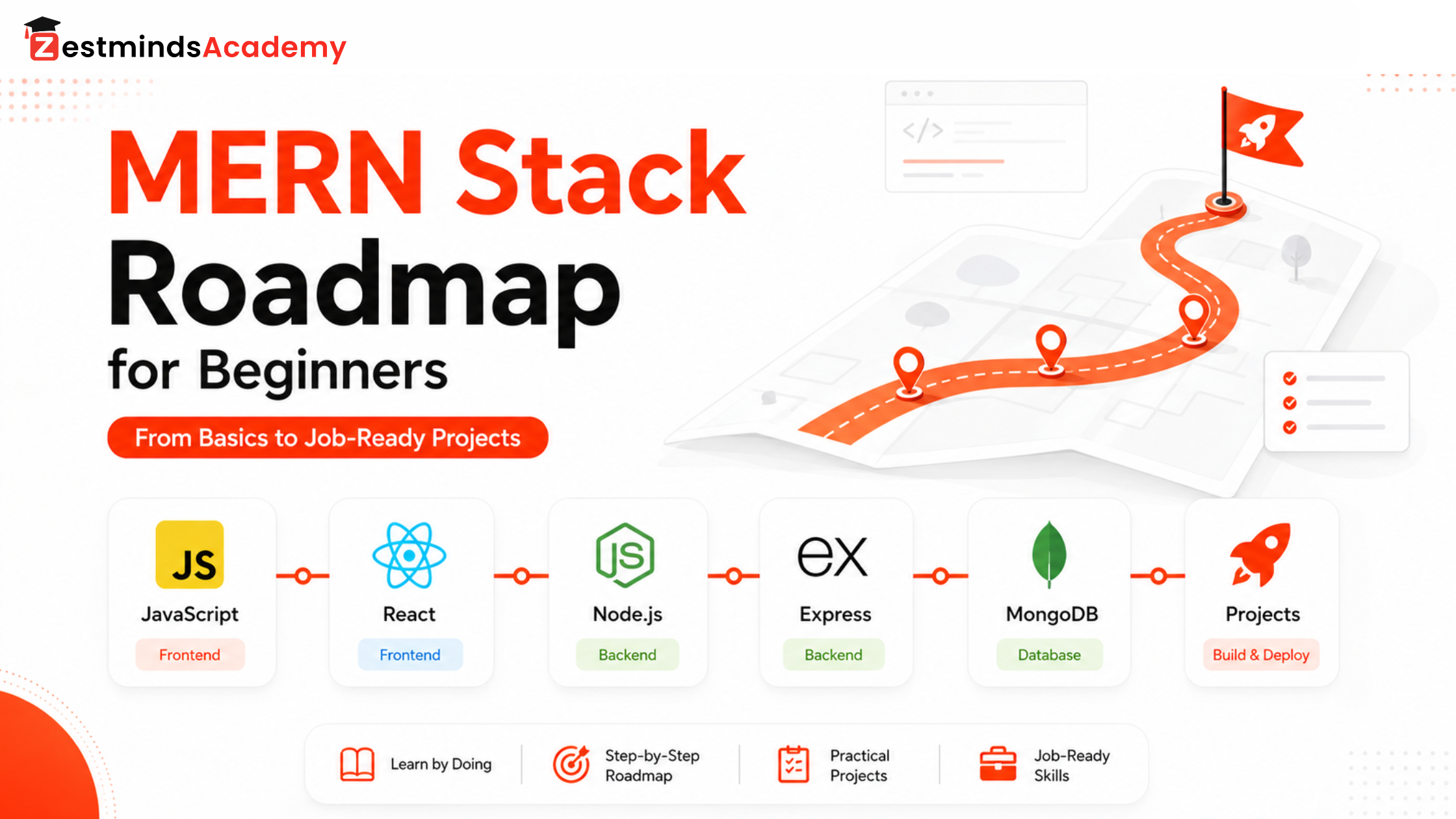
If you are still building your learning path, you can also read this MERN stack roadmap and this guide on what to learn after MERN stack.
Practical MERN Learning Still Matters
Many students do not struggle because they are lazy. They struggle because they learn technology in disconnected parts.
They learn React from one place, Node from another, MongoDB from another, authentication from another, and deployment from another. But nobody shows them how everything connects inside a real project.
That is where practical training helps.
Good MERN training should not only teach syntax. It should teach:
- Why this folder structure is used
- Why this API is designed this way
- Why validation belongs here
- Why authentication needs middleware
- Why database relationships matter
- Why deployment fails even when local code works
- How to debug instead of randomly changing code
For students and working professionals around Mohali, Chandigarh, and nearby areas, mentor-led training can be helpful when they already know syntax but need real project confidence.
At Zestminds Academy, the focus of MERN Stack Training is practical full-stack learning, project structure, debugging, API flow, and development thinking beyond copied code or tutorial-based practice.
For learners looking for a shorter practical program, the 45 Days MERN Training in Mohali page can be a useful next step.
Final Thought
AI is not the enemy of MERN developers. AI is a powerful tool.
But the value of a developer is not only in writing lines of code. The real value is in understanding the problem, designing the system, structuring the project, debugging issues, and making decisions that keep the application maintainable.
The future will not belong to developers who avoid AI. It will belong to developers who know how to use AI properly.
If you already know MERN basics but still struggle with project structure, APIs, backend flow, debugging, and real application planning, the next step is not another random tutorial.
The next step is learning how real full-stack applications are designed.
FAQs
Can AI build a MERN stack application?
Yes, AI can generate parts of a MERN stack application and even create a basic project structure. But developers still need to review architecture, database design, API flow, validation, security, and maintainability.
Will AI replace MERN developers?
AI may reduce repetitive coding work, but developers who understand architecture, debugging, business logic, and full-stack systems will still be valuable.
Is MERN still worth learning with AI tools available?
Yes. MERN is still useful, but the learning focus should move beyond syntax and CRUD toward project structure, API design, authentication, database modeling, debugging, and deployment.
Why do MERN projects become messy?
MERN projects become messy when developers mix UI logic, API calls, validation, business logic, database queries, and error handling without a clean structure.
What should I learn after basic MERN CRUD?
After CRUD, focus on authentication, authorization, API design, MongoDB modeling, React architecture, backend services, debugging, deployment, and Git workflow.
Can I use AI while learning MERN?
Yes. Use AI as an assistant, not as a replacement for understanding. Always test, review, and understand the generated code before using it.
Table of Contents
- AI Has Made MERN Coding Faster, Not Automatically Better
- The Real Problem Is Project Design
- What MERN Architecture Actually Means
- Where AI-Generated MERN Code Starts Breaking
- Frontend and Backend Need Clear Structure
- MongoDB Design Is More Than Creating Collections
- AI Can Help, But It Cannot Own Your Decisions
- What MERN Developers Should Learn Beyond CRUD
- Practical MERN Learning Still Matters
- Final Thought
- FAQs
Raghav Mahajan
Stay Ahead with Expert Insights & Trends
Explore industry trends, expert analysis, and actionable strategies to drive success in AI, software development, and digital transformation.
Begin Your Journey to a Successful Tech Career
Talk to our mentors and choose the right training program.
Call us: +91-9056277961
Email us: hello@zestmindsacademy.com