Will AI Replace Data Analysts in 2027? An Honest Guide for Students and Freshers
If AI can write SQL queries, suggest Excel formulas and create dashboards, why would a company still need a Data Analyst?
This is a reasonable concern for students and freshers planning to learn Data Analytics in 2027. However, generating a chart or query is not the same as producing a trustworthy analysis. AI can create an output, but it may still use incorrect filters, unsuitable metrics or incomplete business context.
Quick answer: AI will automate some routine analytics tasks, but analysts are still needed to understand business questions, verify results and explain what the data means.
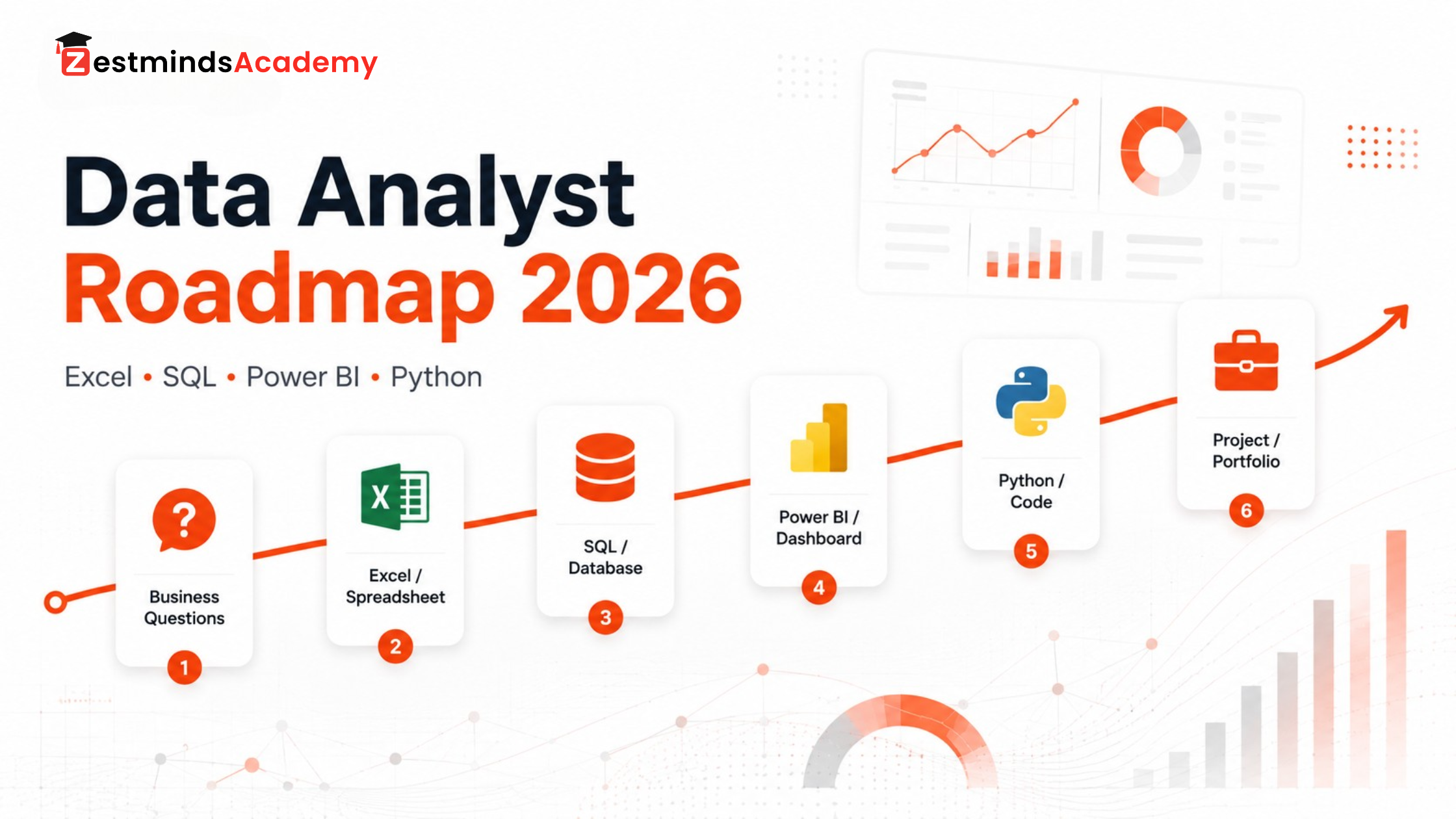
If you are unfamiliar with the role and learning process, start with this Data Analyst roadmap for beginners.
This guide explains what AI can already do, how entry-level roles may change and which skills students should develop. You can also compare practical Data Analytics training options if you prefer guided assignments and project-based learning.

What Can AI Already Do in Data Analytics?
AI can already speed up several parts of an analyst's work. Depending on the tool, it can help with:
- Suggesting Excel formulas
- Drafting and explaining SQL queries
- Generating Python or Pandas code
- Recommending data-cleaning steps
- Creating initial charts and report layouts
- Writing DAX expressions
- Summarising dashboards
- Producing a first draft of a written report
These are not only future possibilities. They are already appearing inside mainstream analytics platforms.
For example, Microsoft explains that Power BI Copilot can help users create and edit reports, write DAX queries, summarise semantic models and answer questions about data. Microsoft also warns that data must be prepared properly. Without suitable preparation and business context, Copilot can return generic, inaccurate or misleading results. You can review these capabilities in the official Power BI Copilot documentation.
Suppose you ask an AI tool to calculate monthly revenue. It may generate a SQL query that runs successfully but:
- Uses the wrong date column
- Includes cancelled orders
- Joins two tables incorrectly
- Counts returned products as completed sales
- Uses revenue when the business actually needs profit
The query may look professional and still give the wrong result. An analyst must determine whether the result can be trusted.
Which Tasks Can AI Assist With—and What Still Needs an Analyst?
A Data Analyst's role contains different activities. Some follow predictable patterns and are easier to automate. Others depend on business understanding, judgment and responsibility.
| Analytics activity | How AI can assist | What the analyst must decide or verify | Main risk |
|---|---|---|---|
| Understanding the problem | Suggest possible questions | Which question matters to the business | Analysing the wrong problem |
| Data cleaning | Recommend corrections | Whether those corrections are valid | Changing legitimate data |
| SQL analysis | Generate draft queries | Joins, filters, definitions and totals | Technically valid but incorrect results |
| Data visualisation | Suggest charts | Which chart communicates the answer clearly | Attractive but misleading presentation |
| Dashboard summaries | Draft observations | Whether the observations are accurate and useful | Missing business context |
| Forecasting | Generate initial projections | Whether the assumptions and data are suitable | Treating an estimate as a certainty |
| Recommendations | Suggest possible actions | What is realistic, ethical and commercially appropriate | Generic or harmful recommendations |
Tasks most likely to become automated
AI is especially useful when a task follows a predictable pattern, such as:
- Producing the same weekly report
- Reformatting data
- Writing basic formulas
- Generating a standard chart
- Summarising an existing dashboard
- Creating first-draft documentation
These tasks may not disappear completely, but analysts may spend less time performing them manually.
Responsibilities that still require human judgment
Businesses do not analyse data simply to create more charts. They analyse it because someone needs to make a decision. An analyst still needs to:
- Clarify what the business is trying to improve
- Select appropriate metrics
- Understand where the data came from
- Recognise missing or unreliable information
- Investigate unusual results
- Explain uncertainty and limitations
- Connect findings with a realistic action
- Take responsibility for the final conclusion
Illustrative example: Sales increased by 18%—but did the business improve?
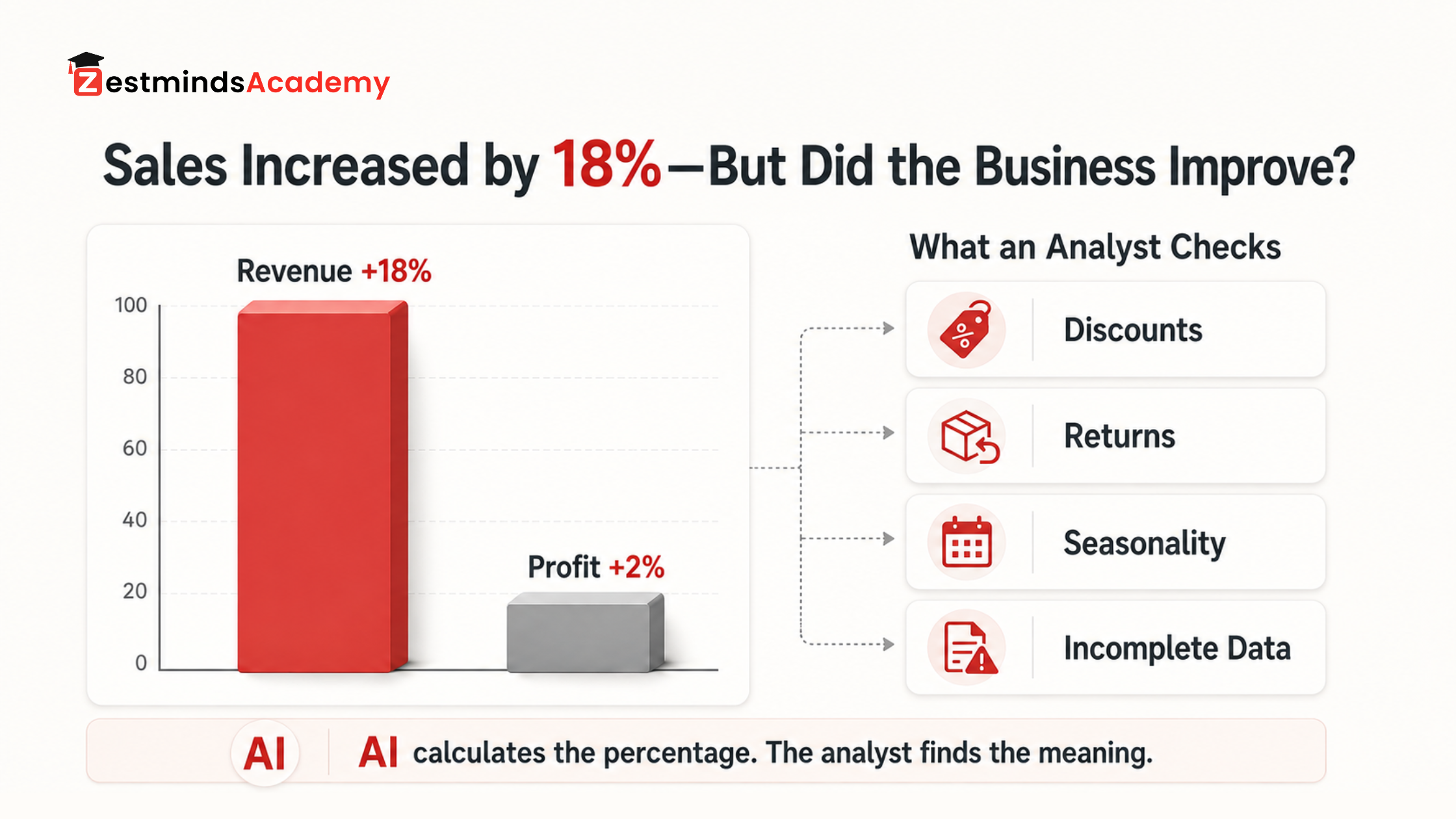
Imagine that an AI tool analyses a retail dataset and reports that sales increased by 18% compared with the previous month.
That sounds positive, but a capable analyst would investigate further:
- Did prices increase?
- Were returned orders removed?
- Was there a festival or seasonal sale?
- Did one unusually large customer create most of the increase?
- Did discounts reduce profit?
- Are both months based on complete data?
After checking, the analyst may discover that revenue increased by 18%, but profit grew by only 2% because the company offered heavy discounts.
AI calculated the percentage. The analyst found the meaning.
Will AI Replace Entry-Level Data Analyst Jobs in 2027?
Some routine entry-level work is likely to change. A company may no longer need someone to spend several hours manually creating a report that an AI-assisted tool can produce more quickly.
Employers may increasingly expect freshers to use AI tools appropriately, check generated work, explain their analysis and document important assumptions.
In a project discussion or interview, a student may be asked:
- Why did you choose these metrics?
- How did you verify the totals?
- What limitations did you find?
- What business decision does the analysis support?
Students who cannot answer these questions may struggle even if their dashboard looks impressive.
This does not mean every entry-level role will disappear. AI adoption will vary by company, industry, budget, data quality and management readiness. Many organisations will still need people who can prepare data, maintain reports, investigate business questions and communicate findings.
The World Economic Forum's Future of Jobs Report 2025 expects AI and big-data skills to grow in importance through 2030. It also highlights analytical thinking and complementary human capabilities. The practical message is that future roles will require a combination of technical and human skills.
If you are still in college, you do not need to predict the entire job market today. Your immediate goal is to build foundations that remain useful even when the tools change.
What Skills Will Data Analysts Need in 2027?
The future-ready analyst is not someone who knows every available tool. It is someone who can use the right tool, verify the result and explain what it means.
1. Strong analytics foundations
Students should build confidence in:
- Excel
- SQL
- Basic statistics
- Data cleaning
- Data interpretation
- Power BI or another visualisation tool
If you do not understand averages, percentages, missing values, duplicates, joins and filters, you will not know when an automated result is misleading.
2. Python and automation basics
Python is useful when a dataset is larger, a cleaning process is repetitive or an analysis needs to be reused. Practical Python for an analyst may include reading CSV files, cleaning data with Pandas, combining datasets and automating repeated steps.
Beginners do not need to become advanced software developers before analysing data. Students who want programming confidence can build a stronger Python foundation, but Python should complement Excel, SQL and business understanding.
3. Business problem-solving
A good analyst asks questions before opening a tool:
- What decision is the business trying to make?
- Who will use this report?
- Which metric actually represents success?
- What period should be compared?
- What could make the conclusion misleading?
For example, “Which product has the highest sales?” and “Which product generates the highest profit?” are not the same question.
4. AI literacy and validation
Students should learn how to use AI and how to challenge it. A safe workflow is:
- Understand the question yourself.
- Inspect the dataset.
- Ask AI for help with one specific step.
- Test the output.
- Compare the result with the source.
- Explain the conclusion in your own words.
Practical rule: If AI gives you a formula, query or conclusion that you cannot explain, do not include it in your project yet.
5. Communication and data storytelling
An analysis is incomplete if the analyst cannot explain it. Students should practise writing clear insights, selecting relevant charts, presenting limitations and connecting findings with possible actions.
A manager may not care how complicated your SQL query was. The manager wants to know what happened, why it matters and what the business should consider doing next.
AI-ready Data Analyst checklist
- Can I define the business question before choosing a tool?
- Can I inspect and clean a dataset?
- Can I write and verify basic SQL?
- Can I choose a suitable chart?
- Can I check AI-generated code and calculations?
- Can I explain the limitations of my analysis?
- Can I document and present an end-to-end project?
You do not need to answer yes to everything before starting. The checklist shows the abilities you should gradually build.
Is Data Analytics Still Worth Learning in 2027?
Data Analytics can still be worth learning, but it is not the right choice for everyone.
It may suit you if you enjoy
- Working with information and patterns
- Investigating why something happened
- Solving structured problems
- Checking details
- Explaining findings to other people
- Connecting numbers with practical decisions
Think carefully before choosing it if you expect
- A guaranteed job after completing a certificate
- AI to complete every assignment for you
- No need to practise outside class
- Only attractive dashboards and no data cleaning
- A high salary without building practical ability
The field is not disappearing, but the easy, tool-only version of it is becoming less realistic.
Can non-technical students enter Data Analytics?
A non-technical background does not automatically disqualify you. Students from commerce, management, humanities and other backgrounds may already understand finance, marketing, operations or customer behaviour. That business knowledge can be useful in analysis.
However, non-technical students must still become comfortable with numbers, spreadsheet logic, basic statistics, SQL, data cleaning and regular practice. Technical learning is still part of the career.
What should parents evaluate?
Parents do not need to judge whether every tool in a syllabus is fashionable. Ask the student to open a project and explain what problem it solves, how the data was checked and what conclusion was reached.
- Does the student work with datasets?
- Are assignments checked and discussed?
- Does the course include Excel, SQL and visualisation?
- Are students taught to verify AI-generated work?
- Does the student complete an original project?
- Can the student explain the project without reading from a script?
No training institute can guarantee employment. Training can provide structure, guidance and practice, but the student must still develop and demonstrate the required skills.
Why Practical Learning Matters More Than Tool-Only Theory
One common beginner mistake is confusing tool completion with skill development. A student may finish an Excel module, write several SQL commands or build a Power BI dashboard and still struggle when given an unfamiliar dataset.
Students often feel confident when their dashboard matches a tutorial. The real test begins when the column names change, values are missing and no one tells them which chart to build.
Practical ability appears when the student can handle the complete process:
- Understand the business question.
- Inspect and clean the data.
- Select an appropriate analysis method.
- Create useful visualisations.
- Verify the results.
- Write clear insights.
- Explain limitations.
- Recommend a reasonable next step.
What should a useful student project demonstrate?
Consider a digital marketing campaign project. A weak project may contain a colourful dashboard showing clicks, impressions and conversions.
A stronger project would explain:
- Which campaign objective is being measured
- How cost per conversion was calculated
- Whether incomplete campaigns were excluded
- Which audience or channel performed better
- Whether a high conversion rate produced profitable customers
- What limitations exist in the data
- What the marketing team should investigate next
Common project mistakes
- Copying a dashboard from a tutorial
- Using a perfectly cleaned dataset without inspecting it
- Adding too many charts
- Ignoring missing values
- Failing to check totals
- Using AI-generated conclusions without understanding them
- Being unable to explain the project during an interview
Students from Mohali, Chandigarh, Kharar, Zirakpur and Panchkula who prefer classroom guidance should evaluate whether a program includes assignments, trainer feedback and genuine project work—not only lectures.
Zestminds Academy offers practical Data Analytics training options with different learning durations. Students can compare them based on their current level, available time and project goals.
Compare Data Analytics Programs
Final Verdict: Will AI Replace Data Analysts?
AI will automate or accelerate some tasks that Data Analysts currently perform. Repetitive reporting, basic query generation, standard summaries and initial visualisations will require less manual effort.
The role will increasingly reward people who understand the problem, prepare trustworthy data, select meaningful metrics, recognise limitations and communicate a useful conclusion.
Do not choose Data Analytics only because someone called it “AI-proof.” Choose it if you are interested in understanding data, solving problems and continuing to learn as the tools change.
If you are unsure which learning duration suits your background, you can compare Data Analytics programs or speak with the counselling team in Mohali before deciding.
Frequently Asked Questions
Will AI completely replace Data Analysts by 2027?
Complete replacement is unlikely by 2027, but the role will continue to change. AI can automate routine work, while analysts will be expected to focus more on business context, problem-solving and communication.
Will AI replace entry-level Data Analyst jobs?
Some repetitive entry-level tasks may require less manual work. Freshers may therefore need stronger projects, better business understanding and the ability to check AI-generated results. This does not mean every entry-level role will disappear.
Can ChatGPT perform Data Analytics?
ChatGPT can assist with formulas, SQL, Python code, explanations and report summaries. Its output can still contain incorrect logic, unsupported conclusions or errors caused by missing context.
Will Excel, SQL and Power BI still be useful in 2027?
Yes. These tools remain important for working with business data. However, students should learn how to analyse and validate information, not only how to use software features.
Do Data Analysts need to learn AI or Machine Learning?
Data Analysts should understand how to use and check AI-assisted tools. They do not necessarily need to become Machine Learning engineers. Basic AI literacy is different from advanced model development.
Do Data Analysts need Python?
Python is useful for data cleaning, automation and larger analytical workflows. It may not be the first requirement for every beginner task, but it becomes more valuable as projects grow in complexity.
Can a non-technical student become a Data Analyst?
Yes, but the student must still learn basic statistics, spreadsheets, SQL, data cleaning and visualisation. A non-technical background is not a barrier, but regular technical practice is necessary.
Is Data Analytics a good career for freshers in India?
It can be a suitable career for freshers who enjoy problem-solving and are prepared to build practical skills. A course or certificate alone is not enough; projects, communication and consistent practice also matter.
Table of Contents
- What AI can already do in Data Analytics
- Which tasks can AI assist with and what still needs an analyst
- Will AI replace entry-level Data Analyst jobs in 2027?
- What skills will Data Analysts need in 2027?
- Is Data Analytics still worth learning in 2027?
- Why practical learning matters more than tool-only theory
- Final verdict
- Frequently asked questions
Mandeep Kaur
Stay Ahead with Expert Insights & Trends
Explore industry trends, expert analysis, and actionable strategies to drive success in AI, software development, and digital transformation.
Begin Your Journey to a Successful Tech Career
Talk to our mentors and choose the right training program.
Call us: +91-9056277961
Email us: hello@zestmindsacademy.com